TALK WITH US +91-9970620335
WhatsApp

Festivals of Kerala

The God’s Own Country has a number of festivals they celebrate, each more vibrant and wondrous than the first. However, these are celebrated at different times of the year. Each with its own relevance and reasoning behind the timing and rituals. From boats racing across the backwaters, to an 800-year-old festival of dance, read all about the festivals of Kerala and when to visit Kerala to experience them.

festival of the harvest
Rooted in years of tradition, the festivals of Kerala are each as interesting and different as the other

Attuvela Mahotsavam

At Attuvela Mahotsavam, lights float gently down the river, a scene straight out of a Disney movie. Entire temples reconstructed on boats light up the night. Flanked by colourful canoes and moving to the thumping beat of the drum, the boats move down the Moovattupuzha river to welcome the Goddess Bhagavathy of Elanku coming to visit her sister Goddess of Kodungalloor on this day. It is known throughout as Elamkavu Attuvela Festival or the Floating Festival of Kerala.

Thousands throng the shore to watch the boats light the way for the grand reunion. In the meenam month of the Malyali calendar, falling between March and April, the two processions begin. Kerala’s temple festivals are characterised by delighted chants, drum beats, elephants and fanfare. In contrast, the Attuvela Mahotsavam is unusually serene and transcendental.

When: In the months of March – April

Watch boats come alive with fantastical lights in Kerala

Theyyam

Rooted in 800 years of folk tradition, Theyyam is one of the most popular festivals of Kerala. Also, Theyyam is a famous ritual art form that originated in North Kerala, consisting of a number of dance and art performances. Each of these demonstrate and brings to life the rich mythological and cultural traditions of God’s own country. Filled with colour, music and a range of mythological acts, Theyyam is a must-witness. 

When: Theyyam falls in the period between April to December

Colourful performaces
Theyyam celebrations in Kerala are a cacophony of colour and festivity!

Boat racing festival

The charming backwaters of Kerala are famous world over. And nothing gets as exciting as watching boats skimming over the surface, rowed by sturdy men racing for the win. Riding mainly on the teamwork and sync between each of the rowers, it is enthralling to watch. The races happen in various locations, but some of the most popular races are the Champakulam Moolam Boat Race (Alappuzha), Nehru Trophy Boat Race (Alleppey), Payippad Jalotsavam (Payippad Lake) and Vallam Kali (Punnamada Lake). Celebrated over three months, this is a festival of Kerala we highly recommend you witness.

When: Boat Festival falls in the period between July to September

Incredible races
Rowers wait with anticipation for the boat race to start (Photo Credits – Avinash Singh)

Onam

Also known as the Harvest festival of Kerala, Onam is celebrated all across India. However, it has originated in Kerala. Accordingly, you can imagine the fanfare in the state that it calls home. Onam’s 10-day celebration is best experienced in Kochi, where a royal parade kickstarts the celebrations. The fanfare is evident throughout Kerala, with colourful floral decorations adorning every home. Music, dances and fireworks fill the air on the main auspicious Onam day. We highly recommend eating a Sadhya meal; the customary feast, it consists of nearly 20 to 25 vegetarian dishes and a few desserts served on a banana leaf.

When: Onam falls between August and September

Rangoli of flowers and leaf
Beautiful flower rangolis (Photo Credits – Rajeev K)

Vishu

Vishu marks the beginning of the New Year for the Malayalis, the ethnic group of people originating from Kerala. This is a festival that is best experienced when staying at a homestay. You will find that it is mostly at home where the fanfare takes place. Take part in a pooja, a religious worship ritual, and enjoy a fulfilling and absolutely delicious Sadhya meal later. 

When: Vishu falls in the month of April 

Plan Your Trip Wisely: Best TIme to Visit Kerala

Rooted in tradition, the dates for festivals of Kerala are decided in accordance with the Malayalam calendar along with the local traditions and customs. Because there can always be changes according to the customs and rituals associated with each place of worship. These months are only an approximate. If you’re looking to travel to Kerala and want to experience a festival, let us know. We can help you plan the ideal trip, just click Plan Your Trip!

Live like a local: Kochi

Kochi is the fifth in our live like a local series. Check out our editions on BangaloreDelhiJodhpur and Mumbai too! Find out where to stay, what to eat, where to go, what to do, what to say and a bunch of extra tips to help you drop the tourist tag.

Kathakali Dance Perfomance Kochi
Kathakali Dance Performance Kochi (Photo Credit – Mayur Nair)

Where to stay

Beena Homestay. Run by the eponymous Beena who serves by day as the Health Inspector of the Corporation of Cochin, so you know the quality won’t be a problem! Well-located and well-managed, you’ll be a sucked into their family life without being imposed upon.

live with a local in kochi, Beena homestay
One of the spacious rooms at Beena Homestay (Photo Credit – Beena Homestay)

What to eat

Hit one of the local toddy shops like Mullapanthal, and pair some local liquor with amazingly exotic dishes like crab, frog legs, rabbit, duck and fish heads cooked Kerala style. Seek out smaller establishments if you want to avoid the college crowds, especially on weekends. These shops are usually open all day but if you go too early the day’s catch won’t be in from the beach yet and if you go too late it’ll be gone. Stop at one of the thattukada (street food) joints for some spicy fried quail and soft buttery parotas.

Local seafood in Kochi
Try the delicious seafood during your stay (Photo Credit – Sharon Ang)

Where to go

Move past the fishing nets to the main harbour in Kochi. Abuzz with life, this may not necessarily be where the locals go to take a break, but it is where you’ll find them. Find a tea stall or awning to shelter under as you people-watch at this throbbing centre of commerce. If you’re approached by a resident you can be rest assured that they’re not a tout.

Chinese fishing nets at Ernakulam harbour (Photo Credit – Suhasdoosra)

What to do

Take the ferry to Vypeen Island. Both the journey and the destination are equally mesmerizing. Drift along the network of backwaters packed tightly between the colourful and curious passengers in their autorickshaws on the car ferry. At Vypeen make your way to Kuzhipilly Beach rather than Cherai for some alone time, especially if it’s a weekday.

Churches in Kochi
The beautiful architecture of Vypeen Island

What to say

Seri Seri. Say it as often as you can, in response to absolutely anything and they’ll take you for a genius. It basically means ‘okay okay’, but it’s used more as punctuation than in actual agreement. Venda (no) will keep the touts away.

Bonus tips:

  • Make a pit stop on the highway when you see a tender coconut stall and make a special request for fizzy coconut water.
  • Carry your heaviest conditioner and lightest cotton outfit because it will be HUMID. SO HUMID. You can never fully prepare for this level of humidity, but you can try.

See Also: Exploring the Perfect Timing for Kerala

Jew Town (Photo Credit – workaholic)

Live like a local: Bangalore

The fourth in our ‘Live like a local’ series that tries to give you the insider scoop to what the long term residents love about their city. Read our Mumbai and Delhi posts also!

colourful nightlife, clubs in Bangalore
Nightlife in India

Where to stay

Villa Camelot. Hosts Yamini and Raghu will offer you more hospitality than the average Bangalorean is used to, but their cosy three-storey in Whitefield blends in seamlessly with the homes of the upper-middle class that bought up the plots when the city was still young.

Have a cup of coffee and one of the many chill coffee shops while you read a book or work
What to eat
Bangalore is a haven for India’s beer lover. The breweries blossoming on every corner epitomize the cooler-than-cool vibe of the city with 60s tunes piped gently into the dimly lit interiors. Toit, Biere Club and Biere Street will make for a great start. Get your fill of a deep-fried South Indian breakfast at Benne Masala Dosa at CTR or Airlines Hotel, go to Faanoos Siddique Kebab or Misbah Kebabs near Johnson market for seekh kebabs, veal, and other Mughlai food. Chicken wing-y finger are best licked at Plan B. Get at least one plate of Ice-cream at corner house, not because they’re mind-melting, but because it’s just what people do. Burgers at Thulp Cafe. Roadside momos.
Delicious meat treats, Street food in Bangalore, Live like a local
Juicy kebabs at Shivajinagar, Bangalore

Where to go

The Bangalore garden city is slowly being mismanaged into environmental oblivion, so pack a picnic and head to Cubbon Park while you still can. If you’re up for a trek and don’t mind sharing the view with hundred-odd other tourists, drive up to Nandi Hills. Book lovers, carve out a whole day for Blossom Book House. Indiranagar is a hub of night-time activity from plays and sketches to stand up and live music. If the night still seems to stretch endlessly ahead of you, we recommend Pebble to dance on the grass under the stars.
peaceful lush green parks
Cubbon Park

What to say

Kannada gothilla. It means ‘I don’t know Kannada’. Not that you’ll be required to speak it, most shopkeepers and auto drivers speak basic English. Call anybody boss for a quick response.
Bonus tips:
  • If your auto driver won’t use the meter, get out. Radio cabs are a much safer bet, they cost the same for none of the hassles
  • If you want to start a conversation with a local, compliment the weather. They will embrace you as one of their own

    green and yello cabs
    Bangalore rick captured in motion, speeding!

Introducing your kids to India

India’s a big fan of families. The rich in history and culture is a great way to introduce your kids to India. We’ve never been big on individualism and the family is seen as the epitome of our great institutions. Travelling with your pack means that you’re already one step closer to blending into the culture. You’ll find yourself better equipped to experience a country that is designed for family life.

For example, most hotel rooms won’t charge extra for children to sleep in the same rooms as their parents regardless of whether it’s a two-person bedroom or not. The same goes for restaurant deals and entrance fees to local attractions. You’ll also be able to avail of endless “Family offers” that basically toss you bulk deals at cheap prices.

First, you can refer to this excellent series of blogs by Gregor and Sarah from Canada on their own experience carting three kids under the age of 15 across the country for two whole months. There’s more here, here and here. Beyond that, we’ve listed some tips specific to travel in India:

Family vacations in India
Our guests in Kumarakom houseboat (Annika Kästle and family)

Food and Drink

  • Eat a lot: India has no dearth of diverse snack foods to keep the kids pumped up. But, you might want to avoid the spices or the street food in view of their more delicate digestion. Of course, you don’t want your child to completely miss out on what is a big part of the Indian experience. Maybe let them have a small bite, but keep medication handy.
  • Remember that not many restaurants here have a kid’s menu because people tend to order a few common dishes for the table and then share them.
  • Hydrate: Yes, it will be hot. Long walks and museum tours aren’t going to help the situation. Carry bottled water with you everywhere. Always mix in a spoonful of flavoured glucose for the kids.
  • Buy your own groceries: Apart from bottled water, you might want to have some milk and cereal on hand for a tender stomach. India has a lot of trusted packaged brands so you don’t have to worry. Opt for a packet of our beloved Maggi instant noodles after a long day.
YTravelling with kids in India
Kids will love touring around in Rickshaws, something completely foreign to them! (Photo Credit – Per Mosseby)

Keeping your kids entertained

  • Carry distractions: The chances of you getting bored in India are pretty slim, but who really knows how kids work? Make sure you have books or games to keep them occupied before they wander off.
  • Sleep well: Constant travelling means that you can let them drop off on buses or trains between destinations. This won’t be as restful as a good night’s sleep in a soft bed. In India, the good news is the hot afternoons drive everyone in for a deep nap after a heavy lunch. But, the bad news is that mosquitoes and insects rule the night so stock up on repellent.
  • Attend workshops: Kids prefer doing to seeing and India can be quite accommodating of this. Not only official workshops but even a street vendor or an auto driver will be quite happy to explain things to children. He may even let them try their hand at it.
  • Encourage them to make friends: Your kids probably want to get away from you after two weeks in the same hotel room so keep an eye out for possible companions. From fellow travellers to local neighbours, it’ll be great for them to see someone their own age for some time. And if it’s a local, they’re more likely to learn about Indian life from them than another tour guide.
The best way to introduce India to your kids
Encourage your kids to make friends with the cheeky local children their age (Photo Credit – Alfie Ianni)

Safety Measures

  • Keep them within your sight at all times: This applies to any sort of travel, but India is exceptionally crowded and often fast-paced. Hold hands, and don’t feel ashamed of tying a little string around a little one’s wrist if it makes you feel safer. Bright shiny objects will call to them from everywhere and you’ve got to be vigilant.
  • Get a doctor’s opinion: While some visa offices make you take certain shots before you leave, they are not your pediatrician. Your pediatrician will be better equipped to give you a personal opinion on what you should prepare your kids for. Bring your medication with you along with a copy of the doctor’s prescription in case of customs hassles.

Find Out: Preparing for Your Journey from the US to India

why visit India with kids
Going to India as a family is not as difficult as one might believe (Photo Credit – ybenyaacov)

Tips for making your life easier

  • Be flexible: Leave buffer spaces in your plans in case someone catches a bad cold or wants to hang out at the zoo a little longer. There’s a fair chance they may decide that they just don’t want to see another fort. Or they may demand to know where the promised tigers are instead, and you might find that you can actually accommodate that. Don’t rush things.
  • Stroller etiquette: India’s not the best city to bump your baby around on wheels. Pavements are often poorly laid or simply non-existent, and many buildings may not have lifts. Opt for a baby carrier if they’re still small enough.
  • Take a trial run: Take your kids somewhere nearby for the weekend just to determine how they feel about being away from home. How much you need to pack and how travel affects them. If you’re preparing for India, introduce them to some of the foods in the comfort of your own home to see how they react.
  • Don’t abandon the familiar: Do they have a favourite brand of peppermints not available here? Carry them. India can often be a wholly alien and often confusing environment for children so it’s good for them to see something from home.
  • Plan nappy changes in advance: Don’t expect to pull into any highway pit-stop and find a changing station. You’ve either got to improvise or look up restaurants and hotels with these amenities in advance. Shopping malls are usually a good bet, but don’t be afraid to lay your baby down on a clean cloth near the washbasins in a pinch.

Learn About: Understand the Travel Requirements from Australia to India

Learn More: Unveiling the Best of India’s Experiences

Let us know if you’ve had any child-friendly (or not so friendly) experiences that we can add to the list!

Family tours across India
Find an activity for the entire family to enjoy like Camel riding through Rajasthan (Photo Credit – Antti Niskanen)
Contact us for Plan your trip now!

The Festival of the Oracles – Kodungalloor Bharani

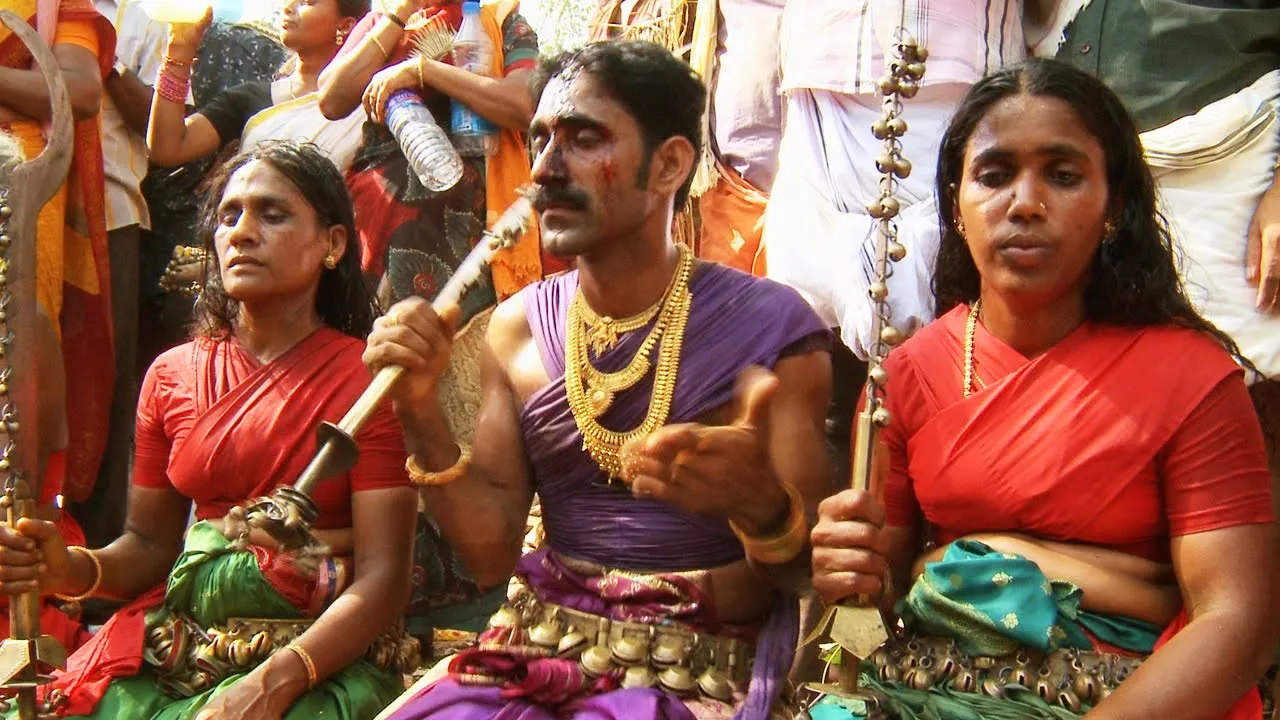
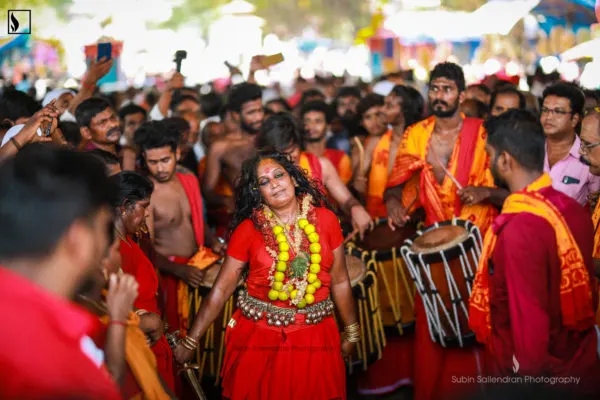
Every year, in the month of meenam (April-March) on the Malyali Calendar, thousands of devotees gather in the Sree Kurumba Kavu Kodungalloor temple (where Festival of the Oracles – Kodunalloor Bharani is celebrated) to sing and chant and cheer the Goddess Kali who resides within.

Legend speaks of her victory in the battle against Darikan that left her raging until her soldiers gathered around her and sang to uplift her mood. Re-enacting that to this day, the devotees gather and sing their Pattu in honour of the goddess.

They do this to seek redemption for their sins. Wrapped in yards of vermillion cloth often stained red with blood.

The Festival of the Oracles - Kodungalloor Bharani
Thousands of devotees gather in the Sree Kurumba Kavu Kodungalloor temple to sing and chant, and cheer the Goddess Kali (Photo Credit – Subin Sailendran)

The festival of oracles

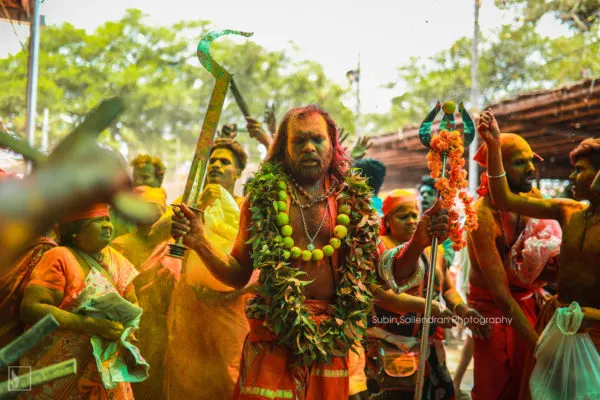
What makes this festival particularly spectacular is a ritual called kaavu theendal. Hundreds of oracles, both male and female, throng the temple grounds for three days. Bedecked in jangling bells and smeared with holy ash, they stumble through the compound chanting and striking at the temple walls, and themselves, with sticks and swords. The devotees lash out at the rafters of the temple, tossing offerings in over the walls.

The festival is one of its kind. It surges with unabated energy that soars on for three days until the local king, seen as the temple keeper, gives blessings to the devotees lying before him. It’s an otherworldly experience that can make you question your beliefs about spirituality and human society. Also, a great reason to travel!

To get to Thrissur ,you can fly directly into Kochi. Most major airports in the country fly to Kochi, or take a train. From there, it’s a quick 3-hour drive or an additional 2-hour train journey.

Uncover the Magic: Best Time to Visit Kerala

The Festival of the Oracles - Kodungalloor Bharani
The festival is one of its kind, surging with energy that soars unabated for three days (Photo Credit – Subin Sailendran)

Celebrating Baisakhi in Punjab

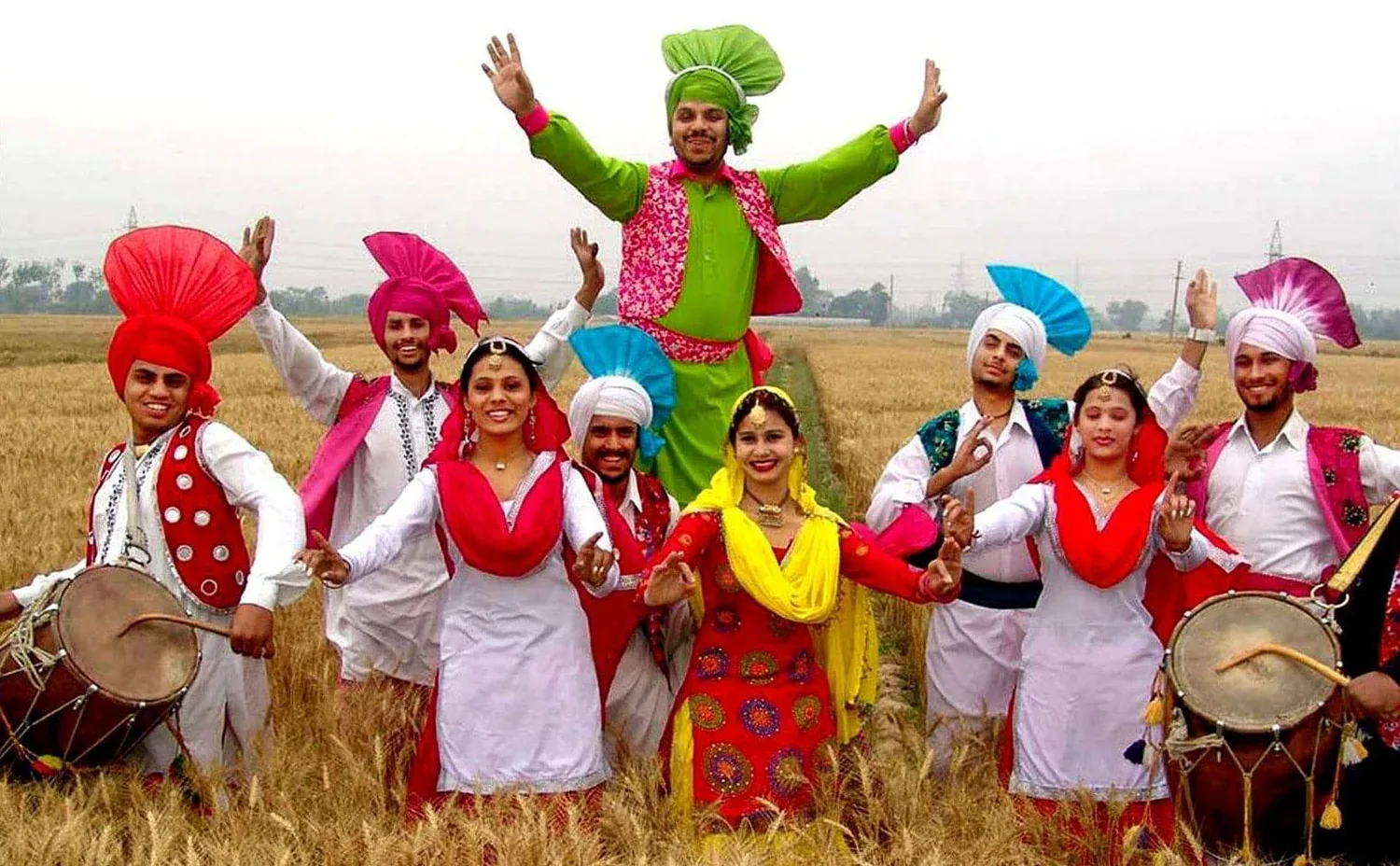
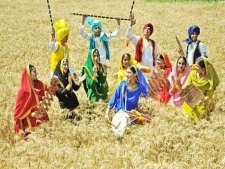
To be a part of a Sikh festival is an intoxicating experience. The sheer passion of the community lifts you out of this world. Farmers and warriors, considered as two sides of the same coin, lead the festivities. They dance the bhangra, inspired by the movements of the agricultural process.

Wonder at the thumping beats of the dholak for the Khalso are pioneers in the field of music and entertainment. Then learn about the rich history of the Baisakhi story and join along with the celebration.

Baisakhi is the lucky draw of festivals, pulling together the Hindu New Year, a harvest festival and the anniversary of the creation of the Khalsa community – the Sikhs. Different regions around the country celebrate the New Year under different names. For example, such as Vishu in the South and Rongali Bihu in Assam. Celebrating Baisakhi in Punjab is the most remarkable experience because it overlaps with the history of the Sikh religion.

Read more about another unique festival in North India.

Celebrating Baisakhi in Punjab
A celebration of the harvest and the anniversary of the Khalsa community (Photo Credit – Mayank Gupta, Flickr)

Baisakhi Story

The story begins with the martyrdom of the nine Sikh Gurus and the ascension of Guru Gobind Singh. When the Muslim ruler Aurangzeb beheaded his father to still the growth of the religion, the tenth Guru decided to instill courage and passion into the peace-loving, agrarian community.

The Baisakhi story has a rich history that dates back to 1699. Here, Guru Gobind Singh gave a rousing speech and called upon volunteers from the crowd to give their lives for the cause. Five men stepped forward, one at a time, and followed him into his tent. Each time the Guru returned alone, fresh blood dripping from his sword. However, the five men were all alive, and a goat had been slaughtered in their place.

They became the ‘Panj Para’ (the beloved five), and the first members of the ‘Khalsa’ (Pure Ones). They had no caste or class demarcation but were a wholly equal community that lives on today and celebrates the founding day of their clan each year.

There are many festivals that take place all over India. If you love festivities read this blog to know more about the celebrations.  

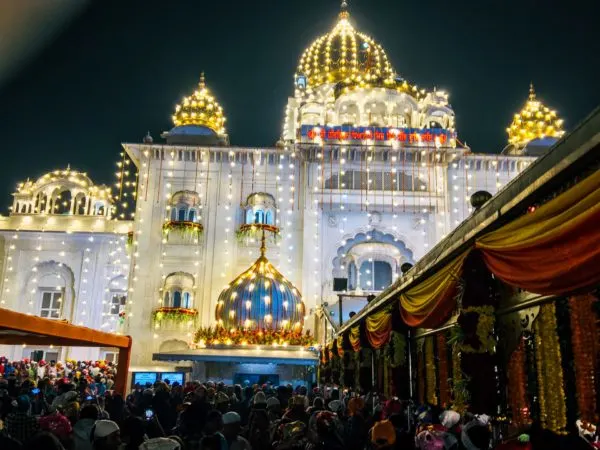
Celebrating Baisakhi in Punjab
Gurudwara Bangla Sahib Baisakhi decoration (Photo Credit – Sushant Sharma)

Celebrating Baisakhi in Punjab

The festival calls for the celebration of life through singing, dancing, parades and wrestling matches. Each echoes the powerful force of life that resides within the Sikhs. They are loud and open-hearted people and they will drag you into the festivities. You will arrive home breathless from dancing and unable to see beyond your full belly.

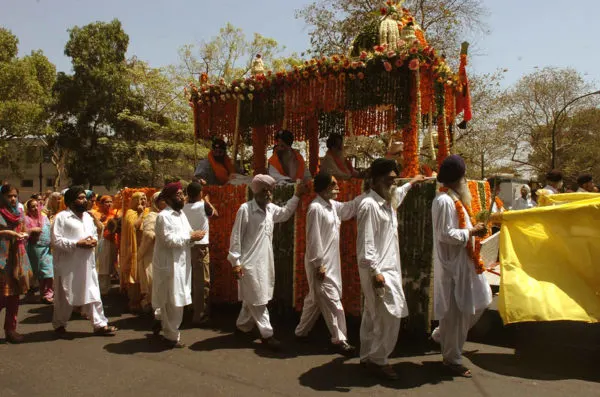
Follow the march of the Nagar Kirtan through the streets as they sing out from the Guru Granth Sahib, the holy book that is revered as the eleventh and final of the Sikh Gurus. Celebrate the Baisakhi story where it originated and get a true sense of Sikh hospitality.

If this community intrigues you, then you must visit the beautiful city of Amritsar.

Celebrating Baisakhi in Punjab
People celebrating Baisakhi festival at Bangla Saheb Gurdwara (Photo Credit – Public.Resource.Org)

Your guide to Mumbai’s Public Transport System

Mumbai has a population of 11.98 million people, with thousands more moving in every day. With traffic like there is, you’ll understand why the Mumbai local trains are lovingly called the lifeline of the city. At the outset, I’d suggest you download m-indicator, an app that’ll help you out with the schedules of trains and buses in the city as well as the accurate fare for an auto or taxi across a certain distance. It’s similar to travel apps in London or Paris and is quite easy to follow. Soon you will be a pro at working out Mumbai’s public transport!

For additional information on what to do in Mumbai, read our Feeling Bombay blog.

Your guide to Mumbai's Public Transport System
Using Mumbai’s public transport is a cheap and easy way to get yourself around the city

Mumbai Local trains

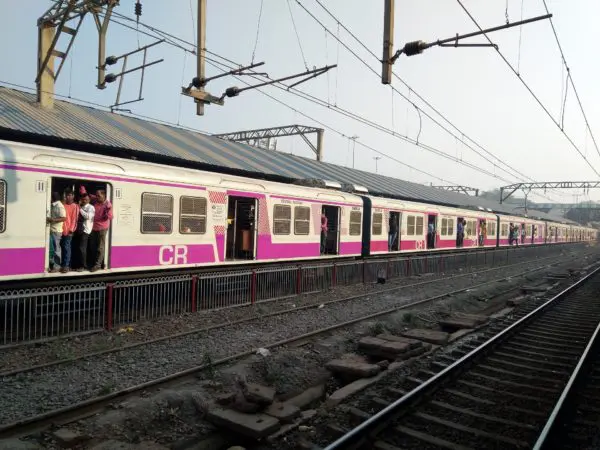
Consider taking Mumbai local trains for a more straightforward journey. This is one of those quintessential Bombay experiences you cannot miss out on. Amateur musicians, vegetable vendors and trinket sellers will keep you occupied throughout if the constantly changing views and myriad people can’t hold your attention.

Choosing a route:

  • Avoid travelling during peak hours, it can be very difficult for the inexperienced traveller.
  • There are three lines: The Central, Western and Harbour lines. The Central and Harbour cross over at Dadar junction if you need to make a change.
  • Find out which station is nearest to your destination and check that it’s on the same line as the one closest to you. Google maps will help you in this.
  • Check the train schedule on m-indicator and opt for a slow train for less of a crowd.

Buying tickets:

  • Mumbai local trains are cheap! Tickets usually cost upwards of INR 10 all the way to INR 30-35 to get to the very edge of the city.
  • Purchase them at dedicated counters outside the station. Fellow passengers will be happy to direct you. DO NOT buy them from a third party standing outside the counter, they might be counterfeit.
  • Keep your ticket with you until you exit your destination station, you may be asked to show it to a ticket checker.
Your guide to Mumbai's Public Transport System
Experience an authentic train journey through the bustling streets of Bombay (Photo Credit – Rehan Ansari)

Buses

These may be a little more inconvenient to figure out but the view they offer is second to none, as their rambling routes will take you around the city often for less than INR 20. You’re in for a real treat if you manage to catch a double-decker!
Choosing a route:

  • This is the really tricky part. Buses tend to have their numbers and destinations displayed on the front, but only in Marathi. The English version is on the left-hand side near the back door. This can be a pain because the bus only stops for a few moments and may move on before you’ve had time to see if it’s the one you want. Ask for help. Fellow commuters or the designated ticket checker will be happy to oblige.
  • Once again, you can figure out which bus number to look out for on m-indicator.

Buying tickets:

  • A conductor on the bus will ask you for your destination and give you your ticket and your change. Don’t hesitate to ask him to let you know when your stop is about to arrive.
  • Tickets usually range from INR 10-30 depending on the length of your journey.
Your guide to Mumbai's Public Transport System
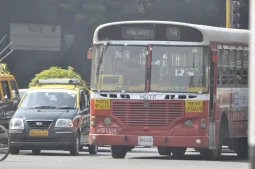
The typical bus you will spot driving around, a popular means of Mumbai’s public transport (Photo Credit – Francisco Antunes)

Metro

Similar to Mumbai local trains, but the monorail is spanking new and still only available in the suburbs. It’s a great ride and one many Europeans will feel at home in. It cuts perpendicularly across the railway lines to help you get to the far-reaching corners of Andheri and Juhu where all the really cool cafes are. Air-conditioned, quiet and startlingly well-behaved, it can provide respite from the hot, crowded streets below.

Choosing a route:

  • The routes are quite straightforward, with stops every few minutes. Just make sure you’re going in the right direction.

Buying a ticket:

  • The monorail operates on the token system. Unfortunately, it does not have weekend or tourist passes for brief stays and you will have to purchase either a single or return token only, or a full monthly pass.
  • Ticket prices range from INR 20-40 for a single journey.
  • If you purchase a return token LOOK AFTER IT.
Your guide to Mumbai's Public Transport System
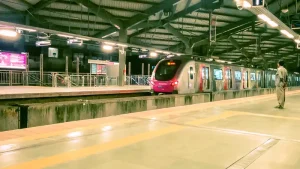
Public transport in Mumbai – The metro (Photo Credit – Ashwin Kumar)

Taxis

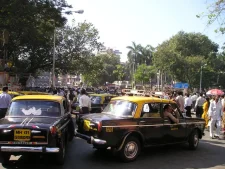
If you don’t fancy the hassle of using Mumbai local trains then consider taking taxis instead. While the kaali-peelis (black and yellow taxis) are recommended for the sheer authenticity of it, we recommend downloading a radio cab app (like Ola cabs or Uber) for security reasons. In case, it’s very late at night or you’re in a hurry and can’t seem to hail a cab, these will assure you of a ride with additional security features as well.

Choosing a route:

  • The local cabs will do their best to overcharge because, in their minds, they think you can afford it and they need the money more than you do. Don’t hold it against them. They are very often wonderful people who will give you some of the greatest conversations of your life. That said, try and follow the route on google maps to ensure they aren’t taking you the long way round. Before you leave your hotel, ask the reception for an estimated fare, and ALWAYS travel by meter, no matter what they insist.
  • Mumbai’s cabs are a blessing compared to the rest of the country. Despite frequent strikes, we still have the lowest strikes and the least complaints of being overcharged or refused. You may have a different experience if you look very obviously foreign, but appeal to their better side and be firm on following the meter.
  • Taxis and rickshaws are the most convenient modes of Mumbai’s public transport.

Prices:

  • As of 2016, the minimum fare is INR 22 and increases at the rate of INR 1.5 per additional kilometre.
Your guide to Mumbai's Public Transport System
Kaali-peelis in Mumbai

Auto-rickshaws

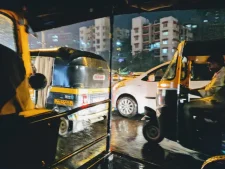
Unless you stop to take hundreds of photos of yourself in one of these, have you really been to Bombay? One of the most popular and cheapest options out of Mumbai’s public transport choices. Super convenient and outrageous in their driving skills, they suffer all the same pricing issues as taxis. They’re more widespread, though they’re not allowed in the old part of the city in the South. The base price here is INR 18 and they seat only three passengers by law.

Explore More: In-Depth Guide to Travel Expenses in India

Your guide to Mumbai's Public Transport System
Rickshaws are a cheap and easy way to get around Mumbai

If you are unsure about when you want to visit India or how to organise your trip, plan your trip with us.

Experiencing the Aoleang Festival of Nagaland

Tucked deep into the forested mountains of eastern Nagaland is Mon, and in Mon are the Konyak Nagas. Life here is endlessly fascinating. They have not let the recent surge in tourist gimmicks dilute their celebration of the arrival of Spring and the New Year. They continue to envelop visitors with their endlessly interesting culture. One of the best festivals in Nagaland is the Aoling festival.

Experiencing the Aoling Festival of Nagaland
The celebration of the arrival of Spring (Photo Credit – www.tourismnagaland.com)

Aoling Festival

The Konyaks come from a strong practice of head-hunting. Among their rooms, you’ll find shelves stocked with skulls in testament to their many victories. Today, they are a happy and peace-loving lot, who spice up their agricultural routine with the occasional hunt.

The rest of the time they just sit back and relax. A pitcher full of local alcohol and maybe a spot of opium is all they need. The tribes in this area live incredibly interesting lives. Being on the border between India and Myanmar and enjoying dual citizenship.

The village chief of nearby Lungwa lives in a hut. This is located right on the border with its half in one country and a half in the other! The big spring feast in this case lasts for a full six days. And takes place immediately after the jhum crop has been sowed.

On the first day or Hoi Lah Nyih, all efforts go into preparation. Accordingly, you will find firewood, vegetables and fruits being collected. Also, new clothes are woven or old clothes are being patched. More interestingly, families sacrifice chickens to read their future in the entrails. As the spirit of preparation continues for the next few days. Young boys undertake the rites of men in the process.

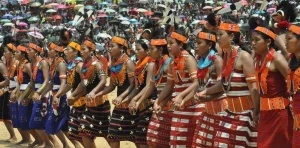
The fourth day marks the big feast. Heady with the local rice beer, the villagers sing and dance and generally make merry. Decked out in traditional handwoven costumes and headgear. They follow the graceful dancing with reenactments of the glorious headhunting days of their past.

The festival will most likely be an experience beyond your imagination. The Northeast still remains cut-off from mainland India. However, there are tensions of identity that must be recognized before categorizing them as an ‘unexplored tribe’.

It will also hopefully shake up your notions of what it is to live with your fellow men. And also the endless cultural intricacies that hold a society together. Isn’t that the point of travel?

Experiencing the Aoling Festival of Nagaland
This will most likely be an experience beyond your imagination (Photo Credit – www.thehindu.com)

Street food in Calcutta to plan your life around

Street food in Calcutta/Kolkata fits itself in neatly with the city’s revolutionary heritage. In a state once ruled by the ‘Babu lok’– the bureaucratic classes. A college student arriving home saying they had already eaten became a form of rebellion. And in response to this new generation seeking to carve it’s a niche on the streets.

Now, they had to give them an excuse to loiter and dissent. Accordingly, the parallel Chinese and Bengali cuisines in the city developed a line of lip-smacking dishes iconic to the age. In this article, we’ll stick to the dishes that are bound geographically with the city. And these cannot be found anywhere else the world over. As the availability and range go beyond what this post can express.

Street food in Calcutta to plan your life around
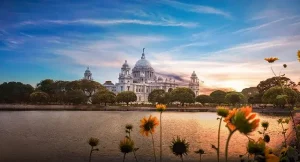
The Victoria Memorial in Calcutta

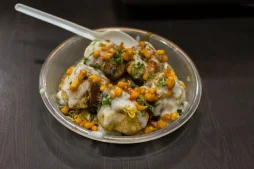
Puchka

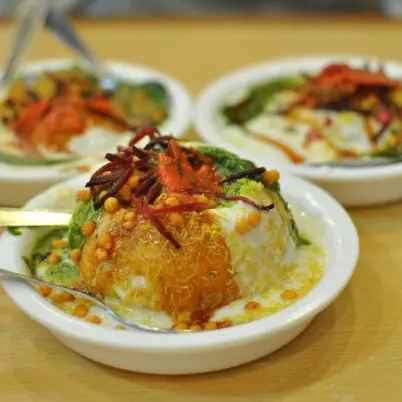
Yes, technically this is available everywhere. But the Bengali version of the Western Pani Puri or the Northern Golguppa is unique in its perfection. Eaten whole, Crisp, airy deep-fried dough cases are cracked open, stuffed with spiced mashed potatoes, dipped into tetul-jol (tamarind water). But before that, it’s being dunked generously into the icy-cold, spicy-hot paani (water). It also comes in a dahi (yoghurt) variety. This is where the paani is replaced with thin sweetened yoghurt.

Street food in Calcutta to plan your life around
Puchka with yogurt

Kathi Rolls

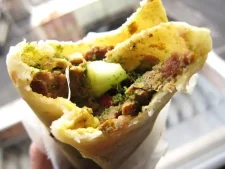
The Kathi roll is all about that filling, a boon for the meat lovers who thought they’d have to go green for this trip. Chicken rolls, mutton rolls, egg rolls, even egg-mutton combination rolls, they’re enough for a full meal. A paratha (flatbread) is stuffed with the meat, vegetable or kebab of your choice, sometimes with a veneer of a beaten egg after being fried on both sides. Then, dripped with an array of sauces and sprinkled with chaat masala and topped off with onions. The paratha is then rolled around the filling and held together with buttered paper or foil for your convenience.

Street food in Calcutta to plan your life around
Like a Frankie or a wrap (Photo Credit – Jason Lam)

Jhalmuri

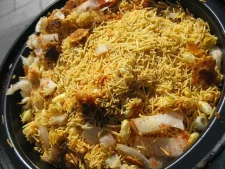
This is a good option for health enthusiasts, served by travelling salesmen in a paper bag. Puffed rice is mixed together with boiled potato chunks and diced onions among many other ingredients. It is then flavoured with spicy and sweet chutneys and maybe some sev or crushed puchka puris.

Street food in Calcutta to plan your life around
Jhalmuri (Photo Credit – Jason Lam)

Ghugni

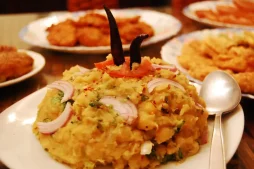
Ghugni is essentially a thick lentil soup made from the black matar daal, a winter favourite. It’s rumoured to be the best around Gariahat. It is served hot with a salad topping of chopped onions and coriander.

Street food in Calcutta to plan your life around
Thick with lentils (Photo Credit – Raasiel)

Chowmein

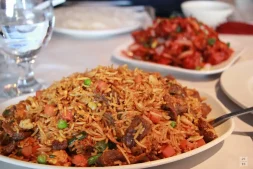
The settling of the Chinese in Calcutta has birthed many great cultural fusions. The most famous would be the delicious Bengali strain of Chinese food. Chowmein is served up in steaming piles, a great value for the student budget. The noodles are distinctly Indian in flavour, full of assorted crunchy vegetables and heavy with oil. You can have it with any variety of meat under the sun or stick to just the vegetarian option.

Street food in Calcutta to plan your life around
Bengali version of Chinese but with added spice (Photo Credit – Can Pac Swire)

Momos

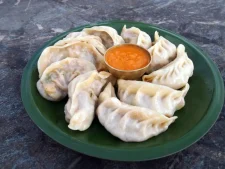
Momos are a soft, moist dumpling stuffed with chicken, pork or vegetables, brought in from Tibet by the refugees. Alternatively, you can have the fried version, crispy and hot. Both are served with an absolutely delicious, super-spicy gravy.

Street food in Calcutta to plan your life around
Momo

Click on Plan Your Trip for your ideal itinerary.

Quench your thirst in India this summer

It can get really hot in India during the summer. We don’t even have the luxury of heatwaves, we have heat tsunamis. Last year, temperatures soared into the high 40s (that’s a 110+ in Fahrenheit). Although global warming might have meddled in the last couple of years, it’s always been hot.

While most rush to the mountains as the first bead of sweat trickles down their backs, the rest of us must make do with rickety fans and iced juices. And in true Indian over-achieving spirit, we’ve stuffed them full of life-saving goodness.

Quench your thirst in India this summer
Chaas, otherwise known as spiced buttermilk (Photo Credit – Scott Dexter)

Nimbu Pani

One of the best ways to beat the heat during the summer is a glass of Nimbu Pani. Also known as Shikanji in North India, it’s just plain Jane Lemonade at first. Then you add a little bit of salt with sugar, soda for bubbles, crushed mint leaves for colour, maybe ginger for flavour and top off the froth with a sprinkling of chaat masala. This will be your summer staple, particularly in Western and Northern India. You’ll find it at INR 10 a glass on every street corner. Though we’d recommend going someplace with tables and requesting mineral water be used in the process.

Quench your thirst in India this summer
A thirst-quenching lemonade-type drink (Photo Credit – Christian Trachsel from Pixabay)

Jaljeera

A further take on the humble nimbu pani, it’s laced with a cumin based mixture that gives it a salty kick. The more posh households will serve it with a topping of boondi-tiny balls of deep-fried dough that soak up all the delicious juice and transform into soft, succulent little miracles.

Quench your thirst in India this summer
A drink with a salty kick (Photo Credit – Caglar Araz)

Tender Coconut Water

Available across the country but the pride and joy of South India. Huge stacks of coconuts lie piled up on carts and makeshift stalls on every lazy roadside. Beside it you will find a rubbish bin that overflows with discarded shells and straws. It’s the healthiest and most delicious option around with the added bonus of slimy coconut flesh to sink your teeth into. The real reason it’s a winner though is the long and elaborate performance by the Nariyal Paani wallah (coconut-water man).

First, you’ll be asked to declare your preference-a coconut heavy with flesh or still tender with water. He’ll then swiftly grab at a few in quick succession, tapping with the back of his knife and listening keenly for a nuance that only his finely trained ears can recognize.

Suddenly finding the perfect nut, he’ll set it firmly against his thigh and commence slicing through the hard exterior to create a pointy tip. Which he will then dramatically behead, stab with a straw and dump in your hands with a theatrical flourish. How can you say no?

Quench your thirst in India this summer
Sweet, refreshing coconut water (Photo Credit – Adriano Gadini)

Chaas/Lassi

Born from the same humble curds, these brothers are dramatically different on your tongue. The first is buttermilk, watered-down curd spiced with salt, chopped up green chillies, mint and coriander, churned to a froth and sprinkled with chaat masala. The second one is the classic Lassi. Thick, smooth and sweet, the still heavy curd is laced heavily with sugar or jaggery and often flavoured with strawberries or mangoes. Thus, giving it the consistency of a yum milkshake!

Quench your thirst in India this summer
A very popular milk drink in Indian – Lassi (Photo Credit – Adam Jones)

Aam Panna

Born out of the flavour of the season-mangoes. This drink captures the cooling properties of the raw Kairi before it becomes a fat ripe mango. Also, famously known to cause heat boils.

The assured freshness of the ingredients, combined with the mangoes natural fortification with vitamins gives this drink, flavoured with salt and spices a particularly medicinal edge.

It’ll be pressed upon you by well-meaning aunties across the country. By fretting at the sweat on your brow and declaring you dead of dehydration without their help. Also rumoured to prevent tuberculosis, anaemia, cholera and dysentery.

Quench your thirst in India this summer
Contact us for planning your trip now!

Let India Someday handle it and plan your best trip.

PLAN MY TRIP subtext