One universal truth about India is that festivals are probably the best firsthand look at its culture. Most have colourful stories and rituals attached to them and the people really know how to have a good time. Let’s just take you through a few of the most famous ones so that you can plan your India travel around a festival in India.
Performing at the beat in music festivals of Rajasthan
Enjoy the festivities of Diwali while travelling in India
It brings in the Hindu New Year – the day Ram, the hero in the ‘Ramayan’ returned home after defeating Ravan, a ten-headed demon who abducted his wife. They call it the festival of lights. It’s easily the most celebrated in India with lamps, lanterns, firecrackers and the Diwali Pooja (prayer ceremony).
When do we celebrate it?
It lasts 5 days starting with Dhanteras and finishing up with New Year. Diwali is the third day, the day of the full moon between October and November. In 2014, it is on 11th Nov (dates keep changing each year according to the Hindu calendar).
Best place to be to enjoy the celebrations
The whole country just lights up, especially North India. In Varanasi, they conduct huge Diwali aartis with elaborate lamps and chants at the Ghats. Rajasthan comes alive and amongst the metros, Delhi has a Diwali worth witnessing.
If you’re travelling to India during the Diwali season, make sure you book well in advance – tickets, bookings, guides. Everything becomes a bit more expensive at this time. A lot of noisy streets and all the smoke from firecrackers are the price you pay for visual delight and superb food.
Festival of lights (sparklers) (Photo Credit – Madhukar Kumar)
Celebrate Holi
This 2-day riot of colours celebrates the bounty of spring. It’s called the “Festival of Colors” and people bathe each other in dry and wet colours, have rain dances, drink bhang (a cannabis paste) and ‘thandai’.
When and where to enjoy the celebrations?
It’s usually the day after the full moon in March (a day before in some eastern parts). In 2014 it’s on March 17. On the night of the full moon, they burn a Holi pyre (on which the mythical demon Holika was burnt) to destroy evil. North India offers unique Holi experiences in Rajasthan, Uttar Pradesh (Barsana, Mathura, Vrindavan), Shantiniketan (Kolkata), other parts of West Bengal and Delhi amongst metros.
Almost every household in India celebrates Holi and it really is fun. The only things to be careful about are checking if the colours you’re using are toxic and if people are largely intoxicated. All in all, the trick to enjoying this one is to stay safe but go into it with no inhibitions.
Onam in Kerala
This is South India’s harvest festival with flower decorations on floors outside all houses. They’re meant to welcome the mythical King Mahabali. People shop and prepare feasts. There’s a lot of song, dance and games but the highlight is the snake boat races. You absolutely must catch one of these.
When and where to enjoy the celebrations?
Celebrated in Malayalam speaking parts of South India, it is really big in Kerala, especially Thrissur with its Puli Kali (tiger play) festival on the last day of Onam. It starts in the first month of Malayalam Calendar and Thiru Onam, the 10th day from Atham is the most celebrated. After Thiru Onam, there are 2 more days of celebration.
If you’re travelling to Kerala during Onam make sure you make advance bookings as ticket prices sky rocket and the best accommodation get occupied quick.
Eleven days of festivities and colourful processions carrying Lord Ganesha idols characterize Ganesh Chaturthi. It is a celebration of the birthday of the Hindu God with an Elephant head. People bring Ganesha statues home and place them in public stalls, worship them for a few days and then submerge (Visarjan) them in style.
Mostly celebrated in the state of Maharashtra and by Maharashtrians elsewhere in India, it falls on the 4th day of the new moon in August or September and lasts 10-11 days. Ananta Chaturdashi (10th day) is the biggest day.
The festivities go hand in hand with heavy traffic, blocked routes and a lot of noise on the streets, especially in Mumbai and Pune.
Ganesh Chaturti in Mumbai (Photo Credit – Chabilleasy Mawa Unsplash)
Pushkar Camel Fair
This 15-day camel trading fair is held in Pushkar, near Ajmer in Rajasthan. People come here in huge throngs. The first 5 days are for camel trading after which pilgrims take dips and conduct rituals in the holy lake. Camels are all decked up and shaved. There are camel beauty pageants, dancing contests, races and what not. Musicians, acrobats, dancers, magicians, carousel rides, snake charmers; this fair has everything you’ve associated with India of the yesteryears and more.
If you’re planning on visiting Rajasthan during the fair, book well in advance unless you want to pay through your nose for an average accommodation. And be careful of godmen and other freeloaders trying to fleece you in Pushkar.
Rajasthan Musical Festival
You camp in the Thar desert (Rajasthan) and revel in 4 days of absolute auditory and visual delight. There’s a bunch of stages, a superb and extremely diverse line-up of music artists from all over, visual art and many more experiences.
There are no fixed dates for the music festival and it keeps changing. If you are interested, keep visiting http://www.ragasthan.com/ to stay in the loop. You should prepare well for extremely cold nights and relatively hot and dry weather during the day’s since you’re going to be outdoors most of the time. Book your passes well in advance, this festival is becoming more famous by the year.
Jodhpur Riff
The Rajasthan International Folk Festival at Mehrangarh Fort in Jodhpur, Rajasthan is a great experience for people any age from any culture. UNESCO calls it a “Peoples Platform for Creativity and Sustainable Development”. It has Sir Mick Jagger for its International Patron. Dates always coincide with the year’s brightest full moon, Sharad Purnima and the festival always has brilliant concerts and events. Again, this is a time of the year when Jodhpur gets very crowded so you should make all your bookings well in advance for a hassle-free experience.
India is a confusing country, and tipping in India is a big question for travellers. We at India Someday have now planned nearly 2000+ trips for people travelling to India. Our expertise has helped us put together a rough guide on tipping in India in various circumstances. This article tells you how much you should be tipping in India depending on the situation or service (like at restaurants, hotel staff and your car drivers). If you do need help with planning your trip, we are happy to help you with candid advice and our own travel experience.
The currency in India, commonly known as the Indian Rupee (INR) (Photo Credit – Shameer Pk)
TIPPING IN India AT A RESTAURANT
India has some great food and you can choose from street food stalls and small restaurants, to high-end experiences. Each of them have a distinctly different tipping etiquette, making tipping in India at restaurants a bit of a confusing challenge.
For street food, no tipping is required. When you pay for a small meal, breakfast or a snack that costs less than INR 300, a 10% tip is appreciated. If you have small bills handy, you can tip in multiples of 10 Rupee notes.
On bills ranging from INR 300 to INR 1,000, you can tip around 7% to 10% of the bill amount. For example, a tip of INR 100 on an INR 1,000 bill is a very good tip. You can also tip about INR 70 and that would be fine. On bill amounts above INR 1,000, a tip of 5% to 7% is sufficient.
Restaurants now often include a ‘service charge’, not to be confused with ‘service tax’ (which is a government-levied tax). No tip is expected if this type of charge is levied. It’s normally capped at 10%.
Fine-Dining Restaurants in India are quite swanky (Photo Credit – Blake Wisz)
TIPPING in India AT HOTELS
In general, hotels have a vast staff that you don’t necessarily get to meet or cross paths with. For that reason, we do always recommend leaving a tip for the entire staff. On average you can tip INR 100 per person/per night at the homestays or hotels you are staying at. So, 2 adults staying in Delhi for 3 nights can tip 2 adults * 3 nights * 100 = INR 600 (Note: Exclude restaurant tips from the general tips to the hotel). Normally at the reception, you would find a central tip box or you can ask if they have one. If not, then tip one central person at the reception and indicate you want it to go to everyone in the staff. If you are young budget travellers/backpackers and want to tip even lower for hotel rooms, you can.
Homestays and B&Bs will usually bill you for meals and extra services at the end so you can tip them then. Do let them know this tip is for the staff, who do the cooking, cleaning etc. Always leave the tip at the end of the stay. Again, a little more than INR 100 per person/per night is enough. Additionally, in India, there will be times when bellboys (individuals who will carry your luggage to your room) wait for a tip at the door. In these cases, you can give them a small tip of INR 10 to 20.
A beautiful hotel in Kochi, Kerala, offering spectacular views
TIPPING CAR HIRES AND GUIDES
Pick up/drops and day tours
When you are being picked up from an airport/railway station or just being dropped off at an airport/railway station you can tip INR 50 to 100.
If you have a car for a day touring the city, depending on your happiness with the service you can tip between INR 200 to 400. Base this on whether he gave you good local tips on places to eat or monuments to visit and whether he avoided tourist traps.
Tipping in India can be bypassed if you take a taxi or a tuk-tuk (rickshaw) from point A to point B after a rate has been negotiated. If you’re interested in more info in relation to tuk-tuks, check this guide out.
Multiple day car hire or guide
Many of our trips include multiple-day car hires with their own drivers, who accompany you anywhere between a few days to a few weeks.
Base your tip on the number of passengers in this instance:
For 1 or 2 passengers, tip between INR 300 to INR 600 per day. So if you had a driver for four days and were very happy you can tip him INR 2,400.
For 3 to 5 passengers, then tip between INR 500 to INR 800 per day.
There have been instances when our drivers have absolutely delighted our guests. The driver has taken them to their village or house, told great stories, and overall taken great care of them. Do feel free to tip above this guideline if you feel like your driver deserves it. There is absolutely no issue with that!
Tipping Guides
You should tip a guide between INR 100 to INR 300 per day. This depends on your level of satisfaction with the guided tour. If it is a group tour then per person INR 50 to INR 100 is a fair tip.
In terms of tipping guides for a more personalized tour, it really depends on how happy you were with the tour and the service. We suggest a wider price range of INR 300 to INR 1,000 (happy to absolutely delighted).
Travelling in an auto rickshaw is a total must for an authentic Indian experience
Tipping in India: TO KNOW
While tipping in India isn’t necessarily a cultural tradition, people expect you to tip in most of the tourist towns. We do recommend tipping at various instances as explained above, but tip higher only when you are very happy with the service. For a more general look at budgeting for your trip to India, this link is a good place to start.
We also encourage tipping higher than the range specified depending on your satisfaction level. This could be in cases where an individual went out of his way for you or in general, you feel like the service was excellent and the increase is more than deserved.
We recommend tipping at various places depending on your satisfaction level (Photo Credit – Dan Smedley)
If you are in the planning process or are thinking about a trip to India, or it’s already planned but need some help with it, do let us know and we can help you plan your trip.
It somehow sounds scarier than travelling alone, but travelling with a group of strangers you’ve only just met can be enormously liberating. With modern technology, it isn’t hard to run a quick, if not thorough background check in a few second.
If you’re travelling with a group of strangers you’ll always have the organisers to fall back on. But what makes it better than doing it all alone instead of travelling with people you know and love?
First of all, it’s as much a route to self-discovery as travelling alone. Constant introductions and relationships with people outside of your comfort zone force you into defining yourself, and test whatever self-concept you had been working with all this while.
People who don’t know if they’re ever going to see you again aren’t likely to tiptoe around your feelings, and they’re more likely to give you an honest reflection of yourself than your close friends. The fifth time you tell someone you’re an avid reader, it may just occur to you that you haven’t really cracked open a book in a while.
Most importantly, you get to re-invent yourself, or simply bring out shades you may have kept hidden because it just didn’t fit in with who your family or friends thought you should be.
Start travelling! (Photo Credit – Avel Chuklanov)
Now get out there and travel. And if you’re still not ready for it, here are some tips to help you work up the nerve.
Don’t hesitate
The great thing about travelling with strangers/semi-solo is that you don’t have to wait for anybody else. If your buddies can’t seem to line up their work leave with yours, or a roommate just can’t seem to save up as fast as you, just pack your bags and hit the road.
The best part is, when it comes to travelling with strangers, this never ends. If you’ve made some friends in a new city and you’ve been exploring with them for nearly a week, they may start to fray your nerves a bit.
Just say your goodbyes and move on. Making lasting connections while travelling doesn’t mean hanging around and being polite when you’d rather just be gone.
Simply pack your bags and hit the road (Photo Credit – นิธิ วีระสันติ)
As you start your first hesitant introductions, your people skills are getting ready to soar through the roof. It’s no cakewalk starting a conversation with a bunch of strangers, even if you have been forced together by fate, or an overzealous travel company.
Soon you’ll be able to gauge body language and facial expressions, even broaden your knowledge of cultural differences in socialising. If nothing else, you may just find out what pick-up line or ice-breaker works best for you. A skill that’s sure to come in handy later on.
Don’t be hesitant to introduce yourself first (Photo Credit – Alexis Brown)
Have a little faith
Granted, these are strangers you’re travelling with, but they’re here for much the same reasons as you. Just like you, they too are often in the same delirious state between being overjoyed and exhausted.
They may not be the people you hung around with in diapers, but you’ve got to trust a little bit and open up if you want some genuine human contact.
Little faith and trust will help you build up genuine connections and memories for life (Photo Credit – Roberto Nickson)
Did you proudly interrupt the guide to share a fact that they later scathingly proved incorrect? Did you have one too many at the bar crawl and throw up on not one but all three of your shiny new friends? Who cares!
What’s past is past and you’re never going to see them again anyway. Lock it away in your secret wild nights and terrible shames box.
Forget the negatives & enjoy the positive! (Photo Credit – StockSnap)
Don’t be afraid to shut the door
Unlike your long term friends who’d think nothing of barging in on you for a casual chat at 3 in the morning, or take offence if you change plans without warning, your new friends are still going to maintain some polite boundaries.
Head out on the city with just your camera in tow and expect bright smiles and welcoming arms when you make it back for 8 o’clock drinks.
New friends have less expectations and will always welcome you with bright smiles (Photo Credit – Helena Lopes)
There is safety in numbers
We are not talking group size, but age. For starters, the body’s capabilities change with age, and you don’t want to be left standing awkwardly off to one side as the 20-somethings jump screaming into the white water rafts.
You’re already being thrown into a chaotic world of strangers, all new sights and sounds and smells. So it’s good to have someone around who’s processing it at the same pace as you.
Opt for age-category specific tours. This isn’t anywhere close to a fast rule though, those who can break it, know who they are.
Opt for a group with same-age category to enjoy your trip to the fullest (Photo Credit – Matheus Ferrero)
Have something to share with your fellow travellers
It’s good to come to the table prepared with something that can help cement your place in the group. Don’t hesitate to share a kickass playlist, home-cooked snacks or riveting stories as they also act as an ice-breaker.
Sharing food, drinks and ideas makes the best evening (Photo Credit – Kelly Sikkema)
Be on time
If you’ve made a plan to be somewhere, stick to it. Your new friends may not be comfortable calling you over and over again to wake you up or otherwise check on you, and you shouldn’t cost them their trip as well.
They’re either going to just leave you behind or never invite you anywhere again. Be careful what you sign up for.
Since you’re less likely to be seeking approval from your temporary friends, you’re less likely to get peer pressured into any activities you won’t enjoy. If you think you’re going to hold back the group, just say no.
Be on time! (Photo Credit – Sanah Suvarna)
Here is our blog which talks about our top ten tips for travelling solo in India. In case you are not sure if you are a group traveller or solo traveller, here is a blog that will help you understand your travel style. Are you ready for it? Feel free to contact us for more details and travel plans.
The festival includes food stalls, cooking competitions, demos and an amazingly exciting live distillation unit will showcase all the deliciousness born out of this fertile and sun-kissed land. The fare on offer comes from the kitchen’s of the biggest five-star hotels and the homeliest of home-cooks so there’s nothing to be missed. To keep you entertained while you eat your weight in coconut and fish, there’s a line-up that includes Goenchim Noketram, Indian Ocean, Dance to the Beats, Rhythm and Blues, Kepemchim Kirnnam, Lagori, the Big T Band, Bollywood Hip Hop and Dance Fusion, Thermal and Quarter, Taaq, Bad Blood and One Night Stand.
Rahul Ram from Indian Ocean (Photo Credits – Abhimanyu Jhingan)
When is this festival?
This festival takes place every year in Panjim during April.
Enjoy the authentic Goan food and music at the festival
Where does the it take place?
The festival is held at the D B Bandodkar Ground, Campal in Goa. Campal is about 4 kms out from Panjim and easily accessible by road and public transport.
We’ll help you plan the ideal holiday while catering to all your needs and interests. Whether its time constraints or budget restrictions, leave it to us and just hit that Plan Your Trip button.
Goan festivals offer some good music and great food (Photo Credits – Joegoauk Last Namegoa)
Every year, over 60 million tulip bulbs travel from Holland to hunker down in the cold earth of Siraj Bagh in Srinagar. Come spring, the first rays of the April sun stretch out over the Zabarwan Range, thawing the shimmering surface of the Dal Lake. The first blooms burst through the soil and unfurl into a carpet of blossoms nearly 5 hectares across. It’s the largest tulip garden in all of Asia.
Rows of different colours of Tulips
WHEN TO Go
The garden, Indira Gandhi Memorial Tulip Garden, opens its gates on the 29th of March. The dates of the actual festival vary depending on the estimated time of blooming. This usually falls between the 5th and 10th of April. The festival lasts for a little under three weeks. Lose yourself in the flowerbeds that have lit up generations of Hindi film backgrounds, swaying in the cool breeze as couples prance wantonly in the sun. Neat rows of yellows, reds, pinks and variegated varieties stretch out as far as the eye can see.
Indira Gandhi Memorial Tulip Garden (Photo Credit – Arif Khan)
Stay for the charming Tulip Festival
Since all these efforts are made mostly to promote Kashmir’s tourism, the Tulip Festival in Srinagar is completed by a huge song and dance bonanza showcasing Kashmiri folk culture and Kashmiri food. Pick up some elegantly embroidered jackets and delicately painted lac boxes to take home. You can also deck yourself out in full Kashmiri kit for a photo op.
The stunning rows of tulips are hard to resist
Getting there
All the major North Indian cities are well connected to Srinagar by road. But you can also catch a flight straight into Srinagar or a train to Jammu.
Go on, Plan Your Trip now to visit to the beautiful Tulip Festival in Srinagar today!
If you’re travelling to India for the rush of Holi, stay on a couple of days to watch Rajasthan celebrate Gangaur festival. Essentially a celebration of womanhood, it defines and honours the role of women in Rajasthani society. What that means is a celebration of marriage and a woman’s ultimate achievement of being a good wife.
Gangaur comes from combining the names for Shiva-Gana and his wife Parvathi-Gauri. Gauri personifies the ideal wife, embodying purity and austerity.
According to legend, these are the days in which Gauri goes back to her parent’s home for a few days until her husband comes to collect her and take her back to their marital home. Thereby the story symbolizes marital bliss and has become one of the most important festivals for the people of Rajasthan.
This is a colourful celebration of woman and marriage (Photo Credit – Nina Luong)
Celebration OF Gangaur IN RAJASTHAN
Colorfully marked, bedecked processions troop through the streets to the sound of drums to mark the departure. Each city puts its own spin on it. In Udaipur, women line up on the shores of Lake Pichola in their finest clothes to set off fireworks, and as a boat procession moves down the water.
In Jodhpur, the women sing as they carry water and grass in brass pots. Whereas Jaipur’s winding procession moves through the city with elephants, horses, folk artists, palanquins, and chariots in tow.
Clay idols of the godly couples are installed and decorated in every home to mark the commencement of the festival. Wheat grains, the grass from which is later used in the rituals, are sown in small earthen pots. While newly married women fast for the entire 18 days for the health of their husbands and their marriage, unmarried women also restrict themselves to one meal a day in the hope of finding a good match.
They spend their days gathered together singing traditional songs to keep their minds off their empty stomachs. On the second day, known as Sinjara, presents arrive from the daughter-in-law’s parents ranging from sweets to clothes and jewelry.
Gangaur Festival in Rajasthan (Photo Credit – Suffix)
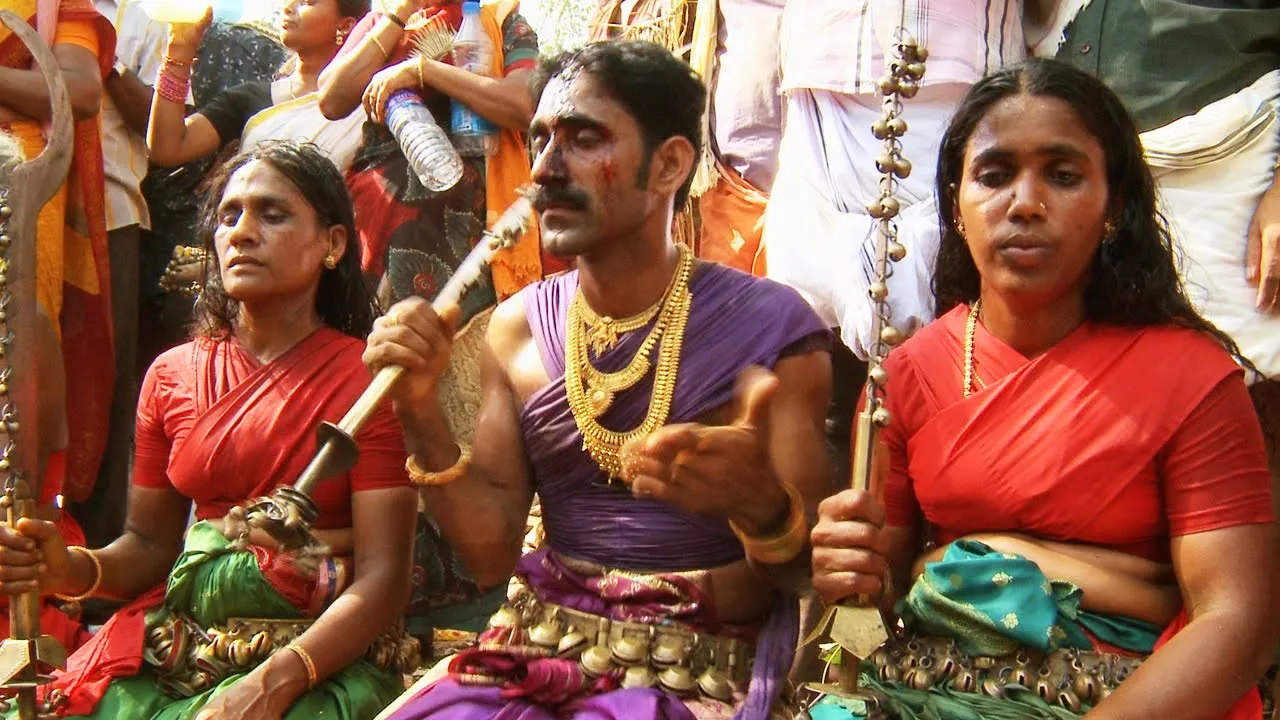
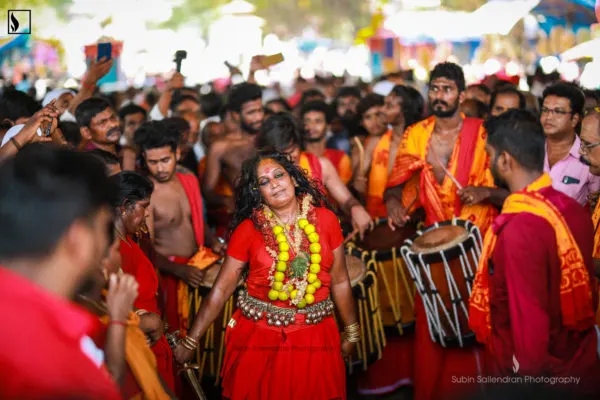
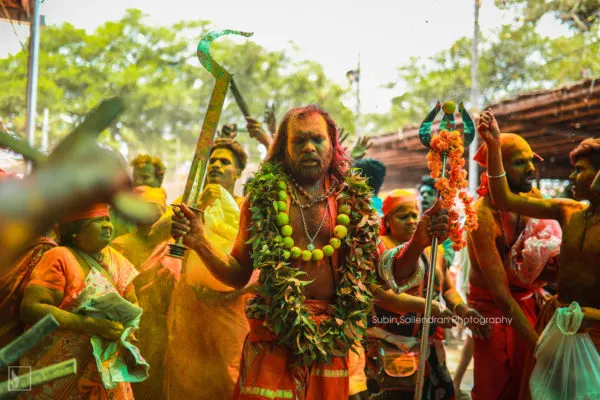
Every year, in the month of meenam (April-March)on the Malyali Calendar, thousands of devotees gather in the Sree Kurumba Kavu Kodungalloor temple (where Festival of the Oracles – Kodunalloor Bharani is celebrated) to sing and chant and cheer the Goddess Kali who resides within.
Legend speaks of her victory in the battle against Darikan that left her raging until her soldiers gathered around her and sang to uplift her mood. Re-enacting that to this day, the devotees gather and sing their Pattu in honour of the goddess.
They do this to seek redemption for their sins. Wrapped in yards of vermillion cloth often stained red with blood.
Thousands of devotees gather in the Sree Kurumba Kavu Kodungalloor temple to sing and chant, and cheer the Goddess Kali (Photo Credit – Subin Sailendran)
The festival of oracles
What makes this festival particularly spectacular is a ritual called kaavu theendal. Hundreds of oracles, both male and female, throng the temple grounds for three days. Bedecked in jangling bells and smeared with holy ash, they stumble through the compound chanting and striking at the temple walls, and themselves, with sticks and swords. The devotees lash out at the rafters of the temple, tossing offerings in over the walls.
The festival is one of its kind. It surges with unabated energy that soars on for three days until the local king, seen as the temple keeper, gives blessings to the devotees lying before him. It’s an otherworldly experience that can make you question your beliefs about spirituality and human society. Also, a great reason to travel!
To get to Thrissur ,you can fly directly into Kochi. Most major airports in the country fly to Kochi, or take a train. From there, it’s a quick 3-hour drive or an additional 2-hour train journey.
Tucked deep into the forested mountains of eastern Nagaland is Mon, and in Mon are the Konyak Nagas. Life here is endlessly fascinating. They have not let the recent surge in tourist gimmicks dilute their celebration of the arrival of Spring and the New Year. They continue to envelop visitors with their endlessly interesting culture. One of the best festivals in Nagaland is the Aoling festival.
The celebration of the arrival of Spring (Photo Credit – www.tourismnagaland.com)
Aoling Festival
The Konyaks come from a strong practice of head-hunting. Among their rooms, you’ll find shelves stocked with skulls in testament to their many victories. Today, they are a happy and peace-loving lot, who spice up their agricultural routine with the occasional hunt.
The rest of the time they just sit back and relax. A pitcher full of local alcohol and maybe a spot of opium is all they need. The tribes in this area live incredibly interesting lives. Being on the border between India and Myanmar and enjoying dual citizenship.
The village chief of nearby Lungwa lives in a hut. This is located right on the border with its half in one country and a half in the other! The big spring feastin this case lasts for a full six days. And takes place immediately after the jhum crop has been sowed.
On the first day or Hoi Lah Nyih, all efforts go into preparation. Accordingly, you will find firewood, vegetables and fruits being collected. Also, new clothes are woven or old clothes are being patched. More interestingly, families sacrifice chickens to read their future in the entrails. As the spirit of preparation continues for the next few days. Young boys undertake the rites of men in the process.
The fourth day marks the big feast. Heady with the local rice beer, the villagers sing and dance and generally make merry. Decked out in traditional handwoven costumes and headgear. They follow the graceful dancing with reenactments of the glorious headhunting days of their past.
The festival will most likely be an experience beyond your imagination. The Northeast still remains cut-off from mainland India. However, there are tensions of identity that must be recognized before categorizing them as an ‘unexplored tribe’.
It will also hopefully shake up your notions of what it is to live with your fellow men. And also the endless cultural intricacies that hold a society together. Isn’t that the point of travel?
This will most likely be an experience beyond your imagination (Photo Credit – www.thehindu.com)
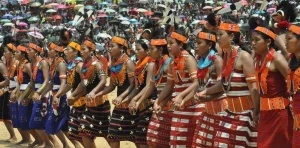
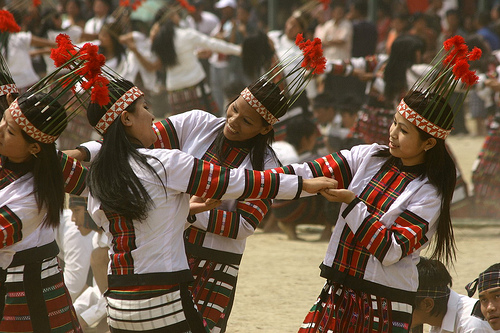
Rumoured to have been around since 1450 AD, Chapchar Kut, the harvest festival of the Mizo tribes tells an eloquent tale of a people, their laughter and endless life. Come early March (1st of March in 2016), jungles of bamboo and undergrowth must be cleared to make way for the summer crop, or the jhum harvest. Once cleared there’s a sudden and welcome break in the otherwise packed schedule of agrarian settlements as they pile up the bamboo and wait for it to dry. It is in this time, that they celebrate.
Photo Credits – www.indiaexchange.org
The cheraw Dance
Colourful traditional attire is dusted off, feasts are prepared and bamboo poles are selected for the crowning dance-The Cheraw. Once the glorious procession of Kut rore is over, where the elders of each tribe parade in representing their individual communities, the dancing begins. The Cherawis a wildly exciting dance of dichotomies, young men pound heavy bamboo poles together against the ground to build a beat while the womenfolk step through them with fascinating dexterity, since missing a beat could mean losing a foot. The festivities are tied up with Then Thumna as local musicians take to the stage and belt out crowd favourites.
While the festival now focuses on song, dance and food, legend has it that the festival was started when the King of a village returned from a hunt empty-handed and ordered his own pig slaughtered so that the village may feast anyway, and the rice-beer (zu) that had already been prepared would not go waste. Along with the missionaries came the eradication of zu and the animistic practices associated with the Kut.
Today the old traditions are revived, but tempered with the Christian history of the community. Locals are quick to share myths and folktales behind various practices, even if they may not hold them true anymore. It’s a beautiful example of a people respecting and appreciating their culture in all its shades without trying to cut out either extreme, but weaving them together into a tapestry of time.
Large number of people gathering on the occasion (Credit_Public.Resource.Org)
At India Someday, we are avid travelers that specialize in assisting travelers plan their holiday to India. Whether it’s flights to India, getting around or accommodation, feel free to get in touch if you have more questions, or fill out our questionnaire to plan your trip accordingly.
Apart from the historic sights and delicious food, there are some must-see museums in Delhi that you should explore if you are a history buff. From modern art to ancient sculptures, regional handicrafts to the history of toilets – here is our list of the 15 must-see museums in Delhi. Are you already planning a trip? Our guide ongetting around in Delhi is sure to help as well!
India National Museum Center
National Museum
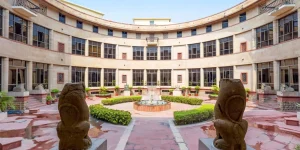
One of the largest and most popular museums in India, the National Museum is a must-visit for anyone interested in Indian history and culture. The museum houses over 200,000 artifacts, tracing India’s history over the past 5000 years.
The museum has different exhibits divided according to themes. From artifacts from the prehistoric era to modern works of art, the diverse departments include archaeology, paintings, arms and armour, and manuscripts. You can even find relics from 4th and 5th century BC, from antiques of the Indus Valley Civilization, the Harappan Civilization, to the artwork from the Mughal era and Buddhist artwork and Buddha relics.
Also known as the National Museum of India, it was proposed by Sir Maurice Gwyer and established in 1949. It is also home to the National Museum Institute of the History of Arts, Conservation, and Museology, added in 1983. Currently, it is maintained by the Ministry of Culture, Government of India.
The museum is disability-friendly. There is a special gallery for disabled people with tactile replicas of some objects, along with Braille labeling, audio guides, and ramps.
Location: Janpath Road, Rajpath Area, Central Secretariat, New Delhi Timing: 10:00 a.m. to 6:00 p.m. from Tuesday to Friday, 10:00 a.m. to 8:00 p.m. on Saturday and Sunday. (Closed on Mondays and public holidays) Entry fee: INR 650 for foreign tourists (this includes an audio guide, available in English, German and French, that covers over an hour of information on the collections)
National Museum
National Gallery of Modern Art (NGMA)
The brainchild of Jawaharlal Nehru, the National Gallery of Modern Art (NGMA) is a haven for art lovers and history enthusiasts. Established in 1954, the museum is located in Jaipur House, the mansion of the former Maharaja of Jaipur. If you want to understand Indian art, this is the place to be. The museum houses one of the largest collections of modern artwork with over 14,000 works on display, dating back to the 1850s. The works include those of Rabindranath Tagore, Amrita Sher-Gil, Raja Ravi Verma, and other renowned artists.
Location: Jaipur House, Shershah Road, India Gate, New Delhi Timing: 11:00 a.m. to 6:30 p.m. (closed on Mondays and national holidays) Entry fee: INR 500 for foreign tourists
National Gallery of Modern Art
National Crafts Museum
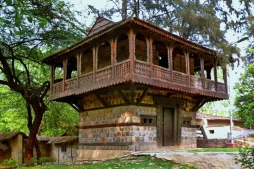
If you want to explore the indigenous arts and crafts of India, you should visit this museum in New Delhi. The National Crafts Museum was renamed The National Handicrafts and Handloom Museum in 1986, and National Crafts Museum and Hastkala Academy in 2019. The museum is designed as a traditional Indian village, with life-size village homes, havelis, and Ayyanar shrines of rural South India. The museum is known for keeping alive the old Indian crafts and weaves, like mithila wall painting, khadi textile looms, ornate temple carvings, and even an intricately decorated Gujarati haveli. It holds the promise of hands-on learning, dozens of photo opportunities, and heavy shopping bags from the artisan courtyard in the back.
Location: Bhairon Marg, Pragati Maidan, New Delhi Timing: 10:00 a.m. to 5:00 p.m. (closed on Mondays and national holidays) Entry fee: INR 500 for foreign tourists
If craft and architecture interest you, get ready to be blown away by some of the most spectacular temples in India. Here are a few must-visit temples when in India.
National Crafts Museum
Shankar’s International Dolls Museum
One of the most unique museums in India, Shankar’s International Dolls Museum is the conceptualization of famous cartoonist K. Shankar Pillai.The museum has more than 160 shelves of dolls from across the world! When the museum was established in 1965, it housed just 500 dolls. Today, there are more than 6500 dolls from over 85 countries, with some dolls over 400 years old!
Sprawled across 5000 square feet, the museum is divided in two sections. The first section has dolls from countries like the USA, Europe, Australia, and New Zealand, while the other section has dolls from Asian countries. There is also a section where visitors can learn the art of doll making, while one section is a “clinic” to restore dolls from the museum.
Location: Nehru House, Bahadurshah Zafar Marg, New Delhi Timing: 10:00 a.m. to 5:30 p.m. (closed on Mondays and public holidays) Entry fee: INR 200 for adults (foreigners) and INR 100 for children (foreigners)
Indian Air Force Museum
The Air Force Museum showcases the history of the Indian Air Force through a collection of artifacts and other memorabilia. Situated in the Delhi Cantonment area, the museum has different viewing galleries.
The indoor gallery features uniforms, vintage personal weapons, photographs, and other items of the Indian Air Force. There is also a hangar which displays wall aircraft and other inventory.
The outdoor gallery has large planes, radar equipment, and captured enemy vehicles. The museum also has large transport aircraft which are displayed on the annual Air Force Day. This museum is a place of pride for Indian citizens.
Location: Air Force Museum, Palam, New Delhi Timings: 10:00 a.m. to 5:00 p.m. (Closed on Mondays, Tuesdays, and public holidays) Entry fee: Free entry
Indian Air Force Museum
Sulabh International Museum of Toilets
If you prefer the bizarre over the ordinary, head to the Sulabh International Museum of Toilets in Delhi, a museum dedicated to toilets. Built in 1992 by social activist and founder of the Sulabh NGO, Dr. Bindeshwar Pathak, the museum has been titled as one of the weirdest museums in the world by Time magazine.
True to its name, the museum showcases the global history of toilets and sanitation. The history of toilets in the museum is divided into three sections – Ancient, Medieval, and Modern. From 2500 BC to the 20th century, the museum has artifacts and exhibits from over 50 countries. It showcases the historical origins of the water closet and toilets used during the Lothal and Mohenjo-Daro civilizations. The museum even displays a fantastic collection of poetry on toilets!
The objective behind this unusual museum is to raise awareness about the sanitation issues faced by the country.
Location: Sulabh Bhavan, Mahavir Enclave, Palam-Dabri Marg, New Delhi Timing: 8:00 a.m. to 8:00 p.m. (10:00 a.m. to 5:00 p.m. on Sundays) Entry fee: Free entry
Sulabh International Museum of Toilets
Nehru Memorial Museum and Library
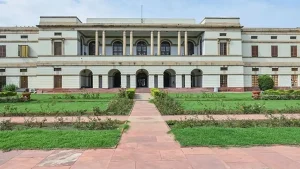
If you want to visit political history museums, the Nehru Memorial Museum and Library is one of the best of Delhi’s museums. The museum was established in memory of Pandit Jawaharlal Nehru, a freedom fighter and the first Prime Minister of India.
Built over 30 acres of land, the complex has a museum in the eastern wing and a library in the western wing, which houses an extensive collection of rare books. A centre for contemporary studies was added in 1990. The complex also has a planetarium.
You can explore his personal rooms, preserved for decades by the museum. The museum showcases his personal life, education, and the journey to becoming the first Prime Minister in his erstwhile residence at Teen Murti Bhavan. You will also find excerpts from his greatest speeches carved into stone in the front of the museum. The museum also has archives of the writings and private documents of Mahatma Gandhi, Sarojini Naidu, Jayaprakash Narayan, Charan Singh, and more.
Location: Teen Murti Bhavan, Teen Murti Marg, New Delhi Timing: 9:00 a.m. to 5:30 p.m. Entry fee: Free entry
Nehru Memorial Museum and Library (Credit: The Financial Express)
National Rail Museum
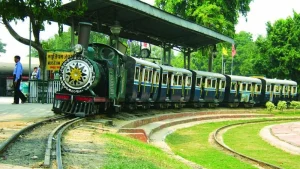
If you love trains, the National Rail Museum in Delhi showcases the rich history and rail heritage of India. Railways in India are the most convenient, complex, common, yet grand mode of transport. With more than 100 real exhibits of Indian Railways, the museum pays homage to this mode of transport. You can find static and working models, antique train furniture, railway equipment, and historical photographs and memorabilia in the museum. The main attractions here are the Fairy Queen, the oldest operating steam engine in the world, and a toy train that provides rides around the museum grounds. You can also find a skull of an elephant that charged the UP mail train in 1894!
Location: Chanakyapuri, New Delhi Timing: 10:00 a.m. to 5:30 p.m. (closed on Mondays) Entry fee: INR 100 for foreign tourists. Audio guide rental INR 150 (available in English and Hindi)
National Rail Museum (Picture Credit: The Asian Age)
The Tibet House Museum offers an insight into Tibetan and Buddhist culture and heritage. The five-storey museum was founded by His Holiness Dalai Lama in 1965, and displays Tibetan art and historical artifacts in the art museum. There are Tibetan paintings decorating the galleries of the museum.
There is an in-house library with over 5000 books and manuscripts preserved carefully. Many of these artifacts on display were brought to India by Tibetans fleeing from their homeland.
Tibet House also has a conference hall, research center, gallery, and a bookshop.
Location: 1 Institutional Area, Lodhi Road, New Delhi Timing: 9:30 a.m. to 5:30 p.m. (closed on Saturdays, Sundays, and public holidays) Entry fee: INR 10
National Science Centre
Established in 1992, the National Science Centre in Delhi will have you hooked with its displays. The museum provides an insight into the history, present, and future of various technologies and developments in India.
Spread over eight levels, the science centre has many interactive activities and games, lectures, exhibitions, and competitions. The Human Biology gallery, Earth Science gallery, and Prehistoric Life gallery showcase various installations and exhibits to teach you science and history in a fun way. The Fun Science gallery has mazes, illusions, and interactive experiments that explain scientific principles.
Location: Bhairon Marg, Pragati Maidan, New Delhi Timing: 10:00 a.m. to 5:30 p.m. (Closed on Holi and Diwali) Entry fee: INR 150 for foreign tourists (rides priced separately)
National Science Centre (Picture Credit: India Map)
Kiran Nadar Museum of Art
The first private museum in India dedicated to contemporary and modern arts, Kiran Nadar Museum of Art was established in 2010 in New Delhi, with another center in Noida. Helmed by Mrs Kiran Nadar, the museum is inspired by the Guggenheim, MoMA, and the Whitney in the USA.
Spread over 18000 square feet, the museum has an elaborate art collection with more than 4500 pieces of art from painters from the 19th century to the present contemporary artists. The most renowned works here are from artists like M.F. Hussain, Raja Ravi Verma, and Anish Kapoor. The museum also has workshops, seminars, exhibitions, and public programs regularly.
Location: Saket, New Delhi Timing: 10:30 a.m. to 6:30 p.m. (closed on Mondays and national holidays) Entry fee: Free
Kiran Nadar Museum of Art (Credit: thedilli)
National Gandhi Museum
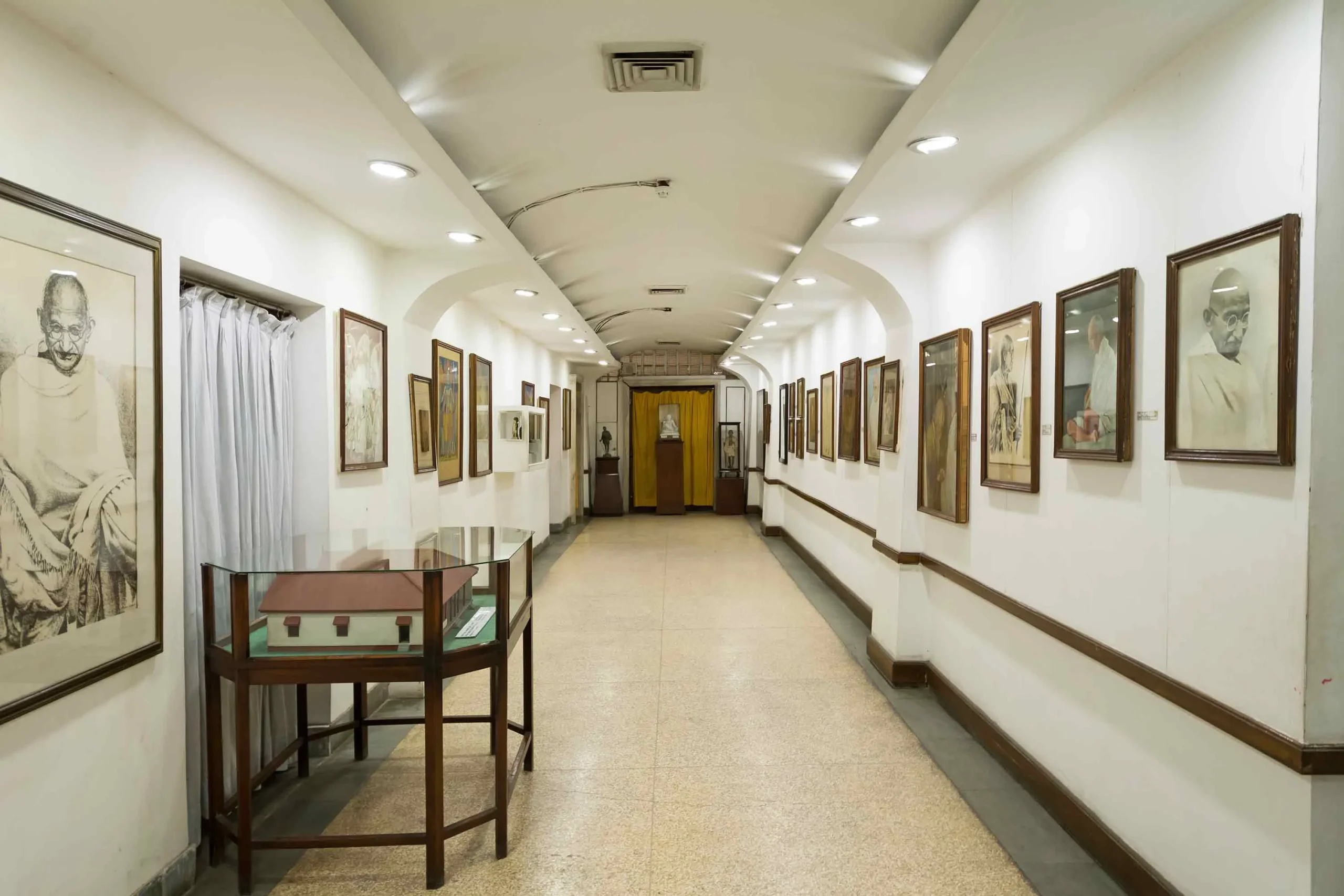
The National Gandhi Museum is a tribute to the Father of the Nation, Mahatma Gandhi. It displays many of Mahatma Gandhi’s personal memorabilia, such as clothes, letters, manuscripts, and journals. The museum also has one of Gandhi’s walking sticks, the dhoti worn by him when he was assassinated, and one of the bullets used to kill him. The museum showcases the history of the Satyagraha movement, the philosophy of ahimsa (non-violence), and the Indian independence movement through sculptures, paintings, and original photographs of Gandhi. Gandhi’s life is shown through a film in English and Hindi in the museum.
Location: Opposite Raj Ghat, New Delhi Timing: 10:00 a.m. to 5:30 p.m. (closed on Sundays and public holidays) Entry fee: Free entry
National Gandhi Museum
Gandhi Smriti Museum
A tribute to Mahatma Gandhi, the Gandhi Smriti Museum is is housed in Birla Bhavan in central Delhi. Birla House, the former residence of industrialist BD Birla, was lent to Gandhi to use. This is where Gandhi spent the last few months of his life, before he was assassinated here in 1948.
In 1973, the Government of India took over the building and turned it into a museum. Gandhi’s room is maintained exactly how he left it, complete with his belongings. The rest of the museum has many artifacts such as terracotta dolls, photographs, sculptures, paintings, and information that are a window to Gandhi’s life.
There is a multimedia show held every day at 1 p.m. at the museum. There is also a khadi store on the museum premises, where one can support this indigenous industry of India.
Location: Birla House, Tees January Marg, New Delhi Timing: 10:00 a.m. to 5:30 p.m. (Closed on Mondays) Entry fee: Free
Gandhi Smriti Museum
Ghalib Museum and Library
The Ghalib Museum and Library is dedicated to the Urdu and Persian poet, Mirza Ghalib. If you love reading and writing, this is one of the best museums for you.
Established in 1969, the museum is a treasure trove for writers and poets. Ghalib’s residences, favorite food, and attire are on display in the museum. There are also photographs, books, sculptures, and important documents from his time. Ghalib Academy, where the museum is situated, also has a calligraphy training center, an art gallery, and a library with a vast collection of books.
Location: Basti Hazrat Nizamuddin, New Delhi Timings: 10:00 a.m. to 6:00 p.m. (closed on Sundays) Entry fee: Free entry
Museo Camera
If you love photography, Museo Camera in Gurugram is the perfect place for you! Museo Camera in Gurugram is the brainchild of Indian photographer, historian, and archivist Aditya Arya. Established in 2009, the museum, dedicated to cameras, showcases unique vintage cameras and photography equipment from more than a century ago! A large part of the artifacts comes from the photographer’s personal collection.
The museum displays historical and contemporary photographs, cameras, and rare photography equipment from around the world. There are many temporary exhibits taking place here, along with film screenings and performances.
The restaurant Fig can be found on the museum complex, if you want to grab a bite!
The museums in Delhi are just one of the many reasons to visit the capital of India. If you want to know more about Delhi,here is our list of things to do in Delhi.
Fromamazing food to rich history, Delhi has loads to see and do. It can also be combined with other destinations likeDharamshala andRajasthan! Curious? Hit thatPlan Your Trip button and let’s get started!
Let India Someday handle it and plan your best trip.