TALK WITH US +91-9970620335
WhatsApp

Auto Rickshaw Guide for Foreigners in India

Traveling from one place to another in an Indian city is easier via auto rickshaw, but hailing an auto rickshaw at a reasonable price can be tricky. Here is an auto rickshaw guide for foreigners in India so that you can travel confidently and comfortably, enjoying the local experience.

What is an auto rickshaw?

Auto rickshaws, autos, rickshaws, bike rickshaws, or tuk-tuks – known by many names, these vehicles are the soul of India’s street transport. The three-wheeled vehicle is the best and easiest way to get from one place to another within the city.

Usually yellow-green or yellow-black from the outside, auto rickshaws are often decorated with colorful pictures, names, slogans, or symbols, making them a part of the street art in India. You will find many unique auto rickshaws during your time in India.

An auto rickshaw ride will expose you to the daily local culture of the city you are in, with traffic, horn honks, street chatter, and chaos all around.

auto rickshaw guide for foreigners in india

Where to find auto rickshaws?

Auto rickshaws are present on most streets in India, from metro cities like Delhi, Mumbai, Bangalore, and Chennai to the smaller cities and towns. Auto stands can be found near airports, railway stations, tourist attractions, and markets, or you can directly hail one from the street.

In many places, auto rickshaws are shared by multiple passengers going the same route, which is an economical option but not necessary if you aren’t on a very tight budget.

There are also apps like Ola, Uber, and Rapido, which offer options of auto rickshaw or cab. This is a hassle-free way of taking an auto from one place to another, since the fares are shown in advance and you can pay online.

auto rickshaw guide for foreigners in india

What is the fare for auto rickshaws?

You will find auto rickshaws running by meter in Mumbai, but almost nowhere else. Although autos are required to use a fare meter by law, most drivers do not use it. So you will need to negotiate the prices for your ride before getting in.

If you are in an auto rickshaw with a meter system, the minimum fare is INR 30 to 50 for the first 1 or 2 kilometers, after which it increases by INR 15 to 25 per kilometer, depending on the city. Always ask the driver to reset and start the meter once they start the ride.

If there is no meter, negotiate the prices beforehand. It is a good idea to ask locals or your hotel or hostel for the average rates. INR 100 to 150 is a reasonable amount for a 5 kilometer ride in most cities.

You can pay by cash or UPI apps if they are accepted. Carry small change, since many drivers try to extract more money by not carrying change.

Tipping is not expected for local transport, but you can definitely round off your fare by INR 10 or 20 – it will be appreciated.

Read more: Negotiating auto rickshaw prices in India

auto rickshaw guide for foreigners in india

What are the common Auto rickshaw scams?

There are many honest auto drivers, but you will surely experience a few who try to take advantage of tourists as well as locals. Here are a few subtle scams you may not see coming.

Non-functioning meter: Many auto rickshaw drivers will tell you that the meter isn’t working and ask you for a high amount of money. You can negotiate the fare or simply choose another auto.

Long routes: If you are traveling in a rickshaw by meter, drivers often take longer routes to rack up the fare. For this reason, it may be a good idea to keep Google Maps on. You can also ask locals or your accommodation beforehand for the estimated fare to your destination.

Detours: Many times, drivers take unnecessary detours to take you shopping for something to a shop that more often than not gives them commission for bringing in customers. If you are not interested, politely decline and ask them to go directly to your location.

No change: A lot of times, when you pay in cash, drivers will tell you they have no change and make you round off your fare. So make sure to carry plenty of spare change.

auto rickshaw guide for foreigners in india

Safety tips

Auto rides are safe for the most part, but as always, it is important to be cautious and aware of your surroundings and take some precautions.

  • Prefer local auto rickshaws only during the daytime, and try to use app-based auto rickshaws during the night.
  • Share your live location with someone you know.
  • Note down the vehicle number before you sit inside the vehicle.
  • If something feels off, it probably is. Ask the driver to stop, preferably in a public area, and try to catch another auto rickshaw.
  • Keep valuables safe and out of sight.
  • It is a good idea to learn some Hindi phrases, especially if you are traveling in the northern regions.


Did you find this blog useful? Let us know! At India Someday, we curate personalized itineraries to India for you based on your likes and preferences. We will also let you know all the insider tips and hacks so that you can truly enjoy your trip like a local. Contact us and together we can plan the perfect trip to India for you!

Spiritual Travel in India

Spiritual travel in India offers you a journey beyond geography – it is the discovery of self. A trip in search of spirituality in India will make you introspect and reflect within yourself. We assure you that you will leave the country feeling enriched and content. Read on to find out more about spiritual travel in India.

Spirituality in India

The birthplace of Hinduism, Buddhism, Jainism, and Sikhism, India has been one of the most important spiritual spaces in the world for millennia. Transcending organized religion, spirituality is less about worshipping deities and more about divine introspection. Every religion has different spiritual paths and ideologies but the same goal: moksha (liberation). There are different forms of practising spirituality, such as yoga, meditation, vipassana, seva, pilgrimage, and satsang.

spiritual travel in india

What are the types of spiritual trips in India?

Pilgrimage tours

Pilgrimage tours are frequently undertaken by millions of devotees every year. Some of the popular pilgrimage tour routes include the Chardham Yatra, Jyotirlinga Temple Tour, Vaishno Devi, Tirupati Balaji, Jagannath Puri, and Rameswaram.

Yoga and meditation retreats

India is the birthplace of yoga and many travel here to experience the numerous yoga and meditation retreats around the country. Rishikesh, Dharamshala, Auroville, and Kerala are the major places where yoga is practiced widely.

Ayurveda and wellness retreats

The land of Ayurveda, India offers many wellness and herbal therapies. Ayurveda is ideal for rejuvenating the mind and detoxifying your body. Kerala, Goa, and the Himalayas are the top destinations for Ayurveda and wellness retreats.

Vipassana

Vipassana is silent meditation, useful for introspection, reflection and healing. India has many silent retreats and Vipassana centers such as Global Vipassana Centre, Osho International, and Tushita Meditation Centre.

Temple trail

For travelers interested in the heritage and stunning architecture of the ancient temples in India, a sacred temple trail can be a good idea. The temples of Khajuraho, Hampi, Madurai, and Konark Sun Temple are magnificent works of art created many centuries ago.

Festival trails

Festivals are a huge part of India, with more than a thousand taking place throughout the year. Some festivals celebrate spirituality and devotion in a big way, attracting devotees and travelers from all over the world. Kumbh Mela, Rath Yatra, Pushkar Fair, Maha Shivratri, Ganesh Chaturthi, Navratri, Dussehra, and Diwali are the biggest celebrations with collective energy.

Ashram stays

Staying in ashrams is a great way to practise discipline and community living. Stay in ashrams like Art of Living, Sri Aurobindo Ashram, Ramakrishna Mission, or Sivananda Ashram and experience simple living. Here, you will be able to participate in seva (service), meditation, yoga, chantings, and philosophical sessions to embrace mindfulness.

spiritual travel in india
Vaishno Devi in Jammu and Kashmir

Which are the best spiritual destinations in India?

Varanasi

One of the oldest living cities in the world, Varanasi is more than 3000 years old. Located along the banks of the sacred River Ganges, this is one of the most spiritual destinations in India. There are 84 ghats lining the river, where people visit to perform pujas and rituals. Taking dips in the river is supposed to rid your body of your sins. Dying in Varanasi is considered to be holy. At the Manikarnika Ghat, cremations continue day and night.

Rishikesh

The yoga capital of the world, Rishikesh is nestled in the Himalayas, with mesmerizing views of snow-capped mountains and pine forests all around. There are many ashrams and yoga centers here, making it a perfect place to experience yoga and spirituality.

Haridwar

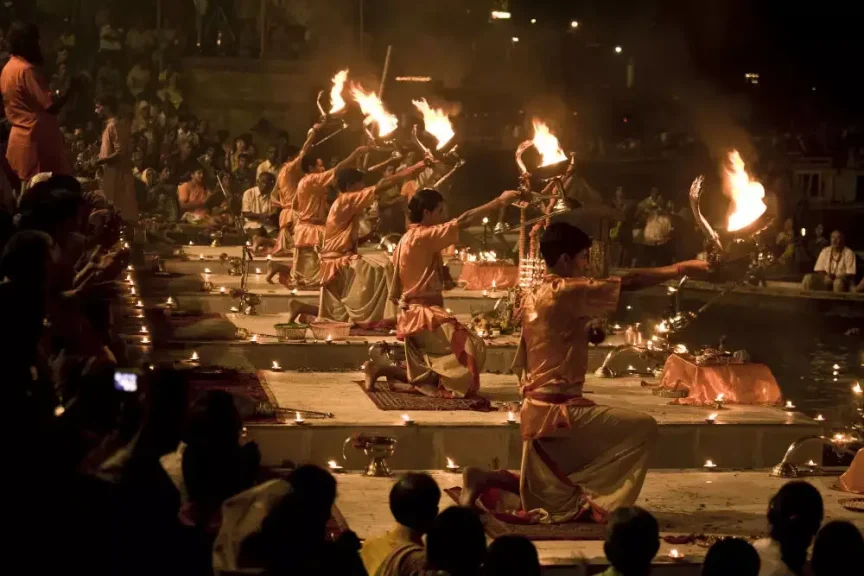
Haridwar is one of the seven holy cities of India, situated at the foothills of the Himalayas. The word literally translates to “Gateway to God”. Devotees believe that a dip in the Ganges here removes sins. Experience the Ganga aarti that takes place every evening at Har Ki Pauri, light oil lamps, and take yoga and meditation workshops.

Amritsar

The Golden Temple in Amritsar is the heart of Sikhism in India. The beautiful temple, Sri Harmandir Sahib, is surrounded by a vast complex. Every visitor is welcome here, and the temple feeds more than 50,000 people daily for free. Visit early morning between 3.30 am and 5.00 am or late at night from 9.00 to 10.00 pm for the best experience.

You can volunteer for Langar Seva, which includes activities like chopping vegetables, preparing food, or serving food.

spiritual travel in india
Golden Temple, Amritsar

Dharamshala and McLeod Ganj

Dharamshala and McLeod Ganj in the Himalayas is a sanctuary for Tibetan Buddhism. McLeod Ganj, known as “Little Lhasa”, is the home of the Dalai Lama as well as the Tibetan government-in-exile. The natural beauty, combined with spirituality, attracts travelers from all over the world. Visit Tsuglagkhang Complex, the residence of Dalai Lama, Namgyal Monastery, Bhagsu Nag Temple and waterfall, and Tibet Museum. Experience spirituality through yoga, meditation, volunteering, and visiting various monasteries. Trekking across Triund or Indrahar Pass is also a great way to reflect and experience mindfulness.

Bodh Gaya

In the state of Bihar at Bodh Gaya under a bodhi tree, Siddhartha Gautama became the Buddha. Bodh Gaya is one of the most important sites for Buddhists all over the world. While the bodhi tree found in the complex today is not the original tree, it was grown from a part of the original, and is protected by UNESCO.

Tirupati

Tirupati in Andhra Pradesh is home to Lord Venkateswara Temple, one of the richest temples in the world. Pilgrims from all over the world visit this temple by climbing up 3500 steps or driving up a ghat. It can take hours to actually view the deity, but it is considered to be a big blessing.

Puri

Puri in Odisha is one of the four sacred points of Char Dham Yatra. Known for the Jagannath Temple, Puri is situated near the sea, rooted in spirituality. Visit the temple, attend Mangala Aarti or Sandhya Aarti, and try the Mahaprasad, offerings that carry the blessings of the deity. Sitting by the sea and meditating is also a beautiful spiritual experience.

Auroville

Auroville is an experimental township for sustainable living and spirituality. Founded on the teachings of Sri Aurobindo, Auroville attracts visitors from all over the world. Meditate at Matrimandir, the heart of Auroville. This golden dome symbolizes the Divine Mother. Reflect near the Banyan Tree, explore the Visitors’ Centre, or participate in different activities organized by Auroville communities. There are daily yoga and conscious movement sessions here as well.

Madurai and Rameswaram

Tamil Nadu is renowned for its Dravidian temple architecture with intricate details carved in stone. These temples have withstood the test of time, remaining unchanged since centuries. Madurai is one of the oldest living cities in India. It is known for the Meenakshi Amman Temple dedicated to Goddess Meenakshi.

Rameswaram is one of the four points of Char Dham pilgrimage circuit and is a part of the Indian epic Ramayana.

spiritual travel in india
Bodh Gaya

Tips for spiritual tourism

  • Respect local customs and religious traditions of the people. Dress modestly while visiting places of religious importance.
  • Don’t try to visit all the spiritual places in India in one trip. Spend more time at fewer destinations. Choose places that you feel a connection with, since every spiritual place in India offers a different experience.
  • Keep your heart and mind open during your travels. Spiritual tourism is more than just a checklist to be ticked – it is about inner reflection, mindfulness, and enlightenment.
  • Be wary of spiritual gurus who charge money for blessings or offer shortcut enlightenment programs.
  • If you are a solo traveler, make sure you inform someone of your plans beforehand.
  • The energy of these spiritual places is sacred. Respect it. Maintain silence often, which is a big part of spirituality.
  • Eat light and sattvic (pure) foods and prefer simple, vegetarian meals.
  • Try to participate in various activities. Volunteer to help in kitchens, join prayers and aartis, take yoga and meditation classes – there is a lot to do in spiritual tourism.
  • It is a good idea to keep a journal of your thoughts and experiences so that you can look back on it after getting home.

Read also: Spiritual Trip to India

Did you find this blog helpful? Let us know! At India Someday, we curate personalized itineraries to India for you based on your likes and preferences. Contact us and together we can plan the perfect trip to India for you!

What to do in emergencies in India: a guide for foreigners

An emergency in an unknown place while you are traveling can be a confusing and frightening experience. This blog is a guide for foreigners about what to do in emergencies in India. From medical emergencies to thefts and accidents, we tell you how to be prepared for any emergency in India.

What are some important emergency contacts in India?

  • 112 – Universal emergency helpline
  • 100 – Police
  • 101 – Fire brigade
  • 102/108 – Ambulance
  • 1091 – Women’s helpline number
  • 1098 – Child helpline
  • 1077 – Disaster Management helpline
  • 1363 – Tourist helpline (Toll-free in India)

What to do in case of medical emergencies in India?

There can be many types of medical emergencies, and such an emergency in a foreign country can be scary.

  • It is important to remain calm in such situations and call for emergency services.
  • If you have a fever or are sick, visit the nearest doctor. Most common viral fevers can be easily cured with doctor’s prescription medicines.
  • If it is more serious, such as a cardiac arrest or an illness, call 102 or 108 for an ambulance. Visit the nearest hospital. Most large cities have good private hospitals like Apollo, Fortis, and AIIMS with international standards.
  • Travel insurance could be very useful in cases like these. Keep your insurance copy and passport handy.
  • Keep a first-aid kit with you while traveling, containing the basic medicines, bandaids, bandages, and sanitizer.

what to do in emergencies in india for foreigners

What to do in case of theft in India?

  • If your bag, wallet, or passport is stolen, file an FIR immediately at the nearest police station. This document will be required for insurance claim and your embassy.
  • If you have a lost passport, you will need to get a temporary replacement passport or emergency travel document to leave the country.
  • If your visa was also stolen, visit the Foreign Regional Registration Office (FRRO) for a visa replacement.

What to do in case of lost money or cards in India?

  • If you have lost your money or debit and credit cards, the first step is to call your bank and block all your cards. Contact the bank’s international helpline for emergency cash assistance.
  • A forex card can help you get quick replacements in major Indian metropolitan cities.
  • You can also visit your embassy if you need help contacting your family to wire emergency funds.

what to do during emergencies in india for foreigners

What to do if you are in an accident in India?

  • If you are in a traffic accident, call 108 or 112 for help. You might find crowds gathering around the place, but most will try to help you.
  • Report the accident at a police station.
  • If you need car rentals, you can contact your rental agency. It is a good idea to have travel insurance in such cases so that you can claim it back.
  • Unless you have experience with India’s local traffic, it is recommended that you do not drive in India.

What to do in emergencies in India: a guide for foreigners

What to do if there is a natural disaster in India?

  • If natural disasters have caused road blocks or flooding, call the disaster management helpline.
  • Keep checking local news and government alerts.
  • Keep emergency items like packaged water, dry food, passport, phone, and charger handy.
  • Stay in touch with your embassy or consulate.
  • If you are in the midst of the action or stranded somewhere, head to the nearest police station or control room.

What should be in your emergency kit?

  • Packaged drinking water
  • Non-perishable, dry food
  • Torch with extra batteries
  • First-aid kit with essential medicines
  • Extra cash
  • Sanitary napkins, toilet paper, sanitizer
  • Emergency contact details
  • Copies of important documents

Read more: Medical travel kit checklist for India

What to do in emergencies in India: a guide for foreigners

Some extra tips

  • Keep local contacts saved in your phone, such as your hotel, guide, embassy, etc. Keep a copy of your emergency contacts on a piece of paper you can carry with you.
  • Keep digital copies of all your documents on your email or cloud storage.
  • Share your detailed itinerary with a few people back home.
  • Keep a first-aid kit and emergency kit with you.
  • Avoid walking alone in isolated areas, especially at night.
  • Use registered cabs or apps like Ola and Uber to travel.
  • Trust your instincts.


Did you find this blog useful? Let us know! At India Someday, we curate personalized itineraries to India for you based on your likes and dislikes. We also help you with useful hacks and practical tips to make your trip seamless and fun. Contact us and together we can plan the perfect trip to India for you!

What power adapter do foreigners need in India?

What power adapter do foreigners need in India? Traveling to this beautiful country is more than just the places you are visiting: the nitty-gritties like these are important, too. With so many electrical appliances used on a daily basis, it is important to find out about the plug sockets and electrical outlets in India. Read on to find out what power adapter you might need in India.

What plug sockets are used in India?

In India, you will find three types of plug sockets: Type C, Type D, and Type M.

Type C: This plug has two round pins parallel to each other. This is the standard Europlug.

Type D: Type D plug has three round pins in a triangle. This is the common Indian 3-pin plug and can be found on most electrical devices.

Type M: This is similar to Type D, but the round pins are larger and more spaced out.

what power adapters do foreigners need in india
USB Type-C

What is the standard voltage in India?

The standard voltage in India is 230 volts.

The standard frequency is 50 Hz.

Do you need a power plug adapter in India?

If the shape of the plugs of your electronic gadgets is not the same as the type of plug outlets in India, you will definitely need a plug adapter. However, a power adapter will only adapt the shape of the plug to fit in the Indian power socket. It will not convert it to a different voltage. So if you need to use devices with high or low voltages, you will need voltage converters as well.

Do you need voltage converters and transformers?

The electricity supply throughout the world varies from 100V to 240V. Using an electrical device at a voltage different from the supply can be dangerous.

The standard voltage for a lot of countries, like India, is 230 volts, so you need not carry a voltage converter. However, countries like the USA and Canada typically operate at 120V. In that case, you may need a voltage converter to regulate your electronic devices.

Most voltage converters and transformers come with plug adaptors, so you may not need to buy a separate travel adapter.

If your devices are dual-voltage, you will only need a plug adapter to match Indian sockets. The label for dual-voltage appliances will read “Input: 100-240V, 50/60Hz”. Single-voltage appliances (110-120V) will need a plug adapter as well as a voltage converter to regulate the voltage.

Read more: Travel checklist for India

what power adapters do foreigners need in india
2-pin plug in India

Electrical adapters for India

Travel power strip

Travel power strips can power many appliances at once and are quite useful. Some power strips convert voltage, feature multiple USB ports, or offer surge protection as well. While they work on lower wattage appliances, converters on power strips do not work on higher wattage appliances.

Power plug adapter

A power plug adapter is lightweight, cheaper, and simple to use. Adapters only modify the shape of the plug, so you will need a voltage converter if your device does not support 230V. It is a good idea to pack more than one type of power adapter.

Plug adapter set

A plug adapter set is more economical than buying individual power plugs. Most sets include different types like A, B, C, D, E/F, G, H, I, J, L, M, and N, so they are suitable for Indian power outlets. This is a good idea if you are traveling to various locations.

Travel USB wall charger

This is a good option when you only have to charge USB devices like cell phones. You can pack just one charger instead of multiple different USB power chargers. However, you will need to get a separate power plug adapter for an Indian power outlet.

What power adapter do foreigners need in india
Travel power strip

Where can I buy a travel adapter?

You can buy travel adapters in stores or online. Research the exact type of adapter you need before shopping. You will also find power adapters at major airports, although the range of adapters may be limited. Before departing for India, the airport will be your last stop to buy an adapter.

In India, you can find power adapters in local electric shops, drug stores, as well as online. It is possible for hotels to have power adapters, although it may not be the type you require. It is better to buy it from a known location beforehand.

Practical tips for using power adapters in India

  • Be well-versed with the socket types in India.
  • You will often find loose plug sockets in India.
  • Power outages, power surges, and voltage dips are also common in India. Make sure to use surge-protected adapters and avoid charging multiple heavy devices at the same time.
  • It is a good idea to label your high-voltage items so that you can use a converter for the necessary appliances.
  • Carry 230V-compatible high-powered devices like hair dryers and irons to avoid any hassles, or use the ones provided by hotels.
  • A universal adapter with surge protection usually supports Type C, D, and M, so it is a great choice.
what power adapter do foreigners need in india
A 3-pin plug

Did you find this blog useful? Let us know! At India Someday, we curate personalized itineraries to India for you based on your requirements and preferences. Contact us and together we can plan the perfect trip to India for you!

Airport Immigration Process in India for Foreigners

India welcomes millions of international travelers every year. To ensure a smooth journey to your destination city, it is important to understand the airport immigration process in India for foreigners. Read on for an extensive guide for the same!

Essential documents for immigration clearance

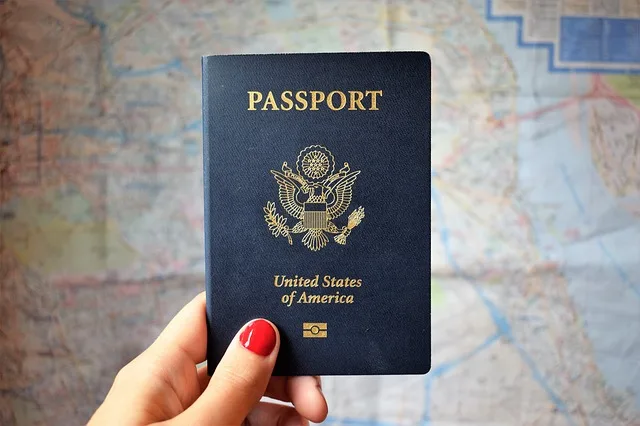
  • Valid passport: Your passport needs to be valid for at least 6 months from your date of departure and must have unused pages.
  • Valid Visa/e-Visa/OCI Card: You need a Visa for India. India offers more than 30 types of visas, depending on the nature of your travel, such as tourist visa, business visa, employment visa, student visa, medical visa, and more.

More than 160 countries are qualified for Indian e-Visa, which also has different categories like e-Tourist Visa, e-Business Visa, and e-Conference Visa.

Overseas Citizen of India Card holders do not need a visa, but they still need to pass the immigration procedures.

  • Return flight ticket: You need a return or onward flight ticket as proof of planned departure from India if you are visiting for a short period.

Read also: Essential travel documents to carry to India for foreigners

Airport immigration process in india for foreigners
You need a valid passport and visa for a smooth immigration process

Before arrival

  • From 1 October, 2025, foreign nationals have to fill in the digital e-Arrival Card online between 72 and 24 hours before boarding your flight to India. The form will ask basic information like your contact information, passport number, purpose of travel, nationality, local address, etc.
  • Before the e-Arrival Card, the immigration process was manual. Airlines distributed a “Disembarkation Card” paper to foreign passengers before landing in India. The same information as above had to be filled by hand.

After arrival

  • Once you land, get your carry-on luggage and deplane.
  • When you enter the airport in India, you need to head to the Arrival Immigration Hall. The immigration counters have two lanes: one for Foreign Nationals, and one for OCI, Diplomats, and Indian Nationals.
  • If you are a foreign national visiting India, you will need to queue at the Foreign Nationals counter.
  • Keep your passport and Visa ready beforehand.

Airport immigration process in india for foreigners

Immigration counter

  • Foreign nationals visiting India for the first time will need to register their Biometric details at the immigration counter.
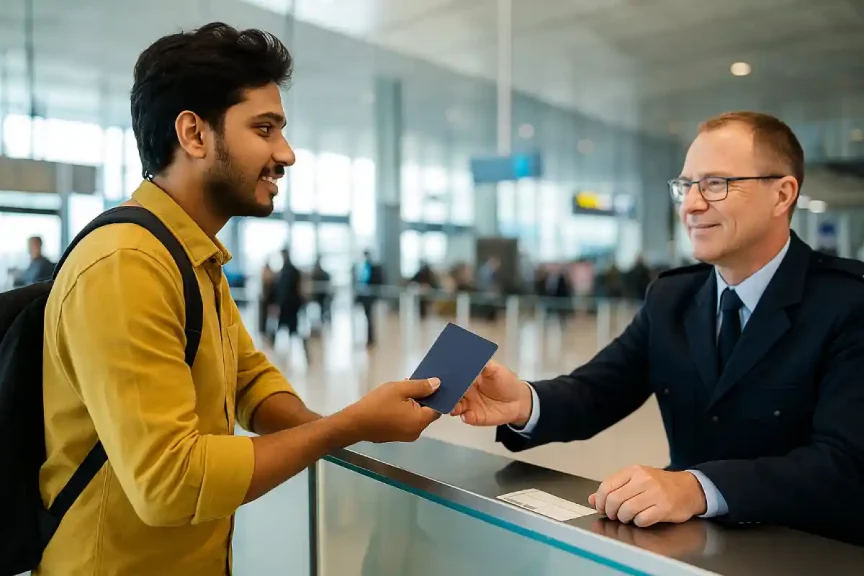
  • An officer at the counter will ask you for your passport, visa, and boarding pass for verification and clearance. They may also ask you some general questions like your purpose for visiting India, duration of your stay, and accommodation address.
  • Then your passport will be stamped and cleared.

Baggage claim

  • After clearing immigration, head to the baggage claim area. The flight information will be displayed on large screens so that you can locate your baggage belt. You will also be informed about it on the flight before landing.
  • Once you spot your baggage, collect it and proceed to Customs.
  • If you need some cash handy, you can find currency exchange counters here as well, before exiting through customs.

Customs

  • Once you reach Customs, you need to clear your goods under the Red or Green Channel. If you have dutiable goods to declare, proceed to the Red Channel. If you do not have any dutiable goods, go through the Green Channel.
  • If you declare your goods wrong, it can result in confiscation of those goods or a fine. Attempts to smuggle gold without declaration can result in arrest and prosecution.

Airport immigration process in india for foreigners

After all these steps, you will be legally allowed to enter into India. You can then exchange your currency and buy SIM cards if you need it, or you can simply exit the airport. You can book an Uber or Ola cab or prepaid taxi from the airport before exiting.


So, did you find this blog useful? Let us know! At India Someday, we curate personalized itineraries for you based on your likes and requirements. Contact us and together we can plan the perfect trip to India for you!

What to do if you lose your passport in India: A guide for Foreigners

It can be quite stressful to lose your passport in a foreign country you are visiting. “What to do if you lose your passport in India: a guide for foreigners” helps you navigate step-by-step through the process of recovering or getting a new passport along with a few tips. Read on to find out more.

Recheck everywhere

Check and recheck all your bags, rooms, and belongings thoroughly to make sure that your passport is definitely lost and not misplaced.

Remain calm

Yes, losing a passport can definitely send you in panic mode, but the first thing to do is to remain calm so that you can think things through. It is scary to lose a passport, but there are ways to fix the situation. Make sure you have access to all your other essential documents, such as your original ID or copies, some cash, or cards.

File an FIR

  • Then, go to the nearest police station immediately to file an FIR (First Information Report). Let them know that your foreign passport has been lost or stolen.
  • They will ask you for details such as your name, nationality, visa type, passport number, and where it got lost or stolen.
  • Ask for a copy of the FIR, NCR (Non-Cognizable Report), or a document of acknowledgement from the police, which you might need at your embassy or consulate.
  • If you have a digital or physical copy of your passport and visa, it will help a lot.
what to do if you lose your passport in india
File an FIR

Contact your embassy or consulate

  • Once you get the police report, contact your consulate or embassy in India.
  • Your embassy or consulate will help you apply for a temporary passport or emergency travel document.
  • You will need to submit some documents like the police report, copies of your passport and visa, ID proof, and passport photos.
  • Pay the applicable fee.
  • Your embassy will issue an emergency travel document within a few days.

Visit the FRRO in India

  • If you also lost your visa along with the passport, you will also need a visa replacement or exit permit from the Foreigners Regional Registration Office (FRRO).
  • First, you need to apply online via https://indianfrro.gov.in. This is necessary before you visit the FRRO nearest to you.
  • Carry documents like a copy of the police report, a letter from your embassy or consulate confirming the issue of your new passport, digital or physical copies of your passport, proof of stay in India, and a few passport photos.
  • If you have plans of staying longer in India, apply for a visa reissuance. The replacement Indian visa, once issued, will let you continue your travels.
  • If you plan on leaving soon, apply for an exit permit. This visa is valid for a single exit and it should match your flight date. It takes around 2 to 5 days, although it can be quicker for emergency cases.

Make copies of the documents

Once all these steps are completed, make multiple digital and printed copies of all the documents: FIR report, embassy letter, emergency temporary passport, visa/exit permit, and flight tickets.

Reconfirm flights

Once you get your exit permit or visa, book a new flight or reconfirm your original flight. Travel insurance may help you reimburse the flight costs. Airlines will check the documents like your new passport, exit permit, ticket, and police report. Even if you get an emergency passport, your airline will not let you board without a visa or exit permit.

what to do if you lose your passport in india
Reconfirm your flight tickets

Departure process

While leaving India, immigration officers will verify your temporary passport and match it with your exit permit number. They will stamp “exit” and keep a record of your lost passport. Keep all your documents in order for a smooth procedure.

What to do after returning home?

  • After you are back in your home country, you need to apply for a new permanent passport.
  • Inform the authorities that your old passport was lost – it will be marked as canceled.
  • You may also need to update your visas and IDs.
  • Claim your travel insurance, since most insurance companies refund fees for passport replacement and visa reissue, lost luggage, flight changes and hotel extensions.

What if you lose your visa, ID, cards, and cash along with your passport?

  • It is quite possible that your entire bag containing all your documents gets misplaced or stolen.
  • If that happens, go to the nearest hotel or police station, calm down, and file an FIR. request a stamped document explaining that all your belongings were lost or stolen.
  • Your embassy or consulate can verify your identity using previous passport records or biometric data, personal verification, and any digital information from your country’s database.
  • You can also ask your embassy to help you contact your family or friends back home who can wire you money.

Read also: e-Visa and Visa on arrival for India

What to do if you find your passport after filing a report?

It is quite possible for you to find your passport after you have already filed a report and maybe even applied for a replacement passport. Here is what you should do in that case:

Inform the police immediately

Go back to the police station where you filed the FIR and tell them you found your passport. The police will cancel or amend the report to show that your passport has been recovered or they will issue a new certificate that confirms the recovery of your passport. This is an important process because the authorities may check the FIR status.

Contact your embassy or consulate

If you have not received a new passport, inform your embassy immediately. They can cancel the replacement request and you can continue using your original passport. If you have already received your temporary emergency passport, your embassy may ask you to keep the emergency passport to travel and exchange it for a permanent passport once you are back in your country. Usually, if your replacement passport has already been issued, you cannot keep using the original passport since it is cancelled in the embassy system.

Keep all documents with you

Keep all the correspondence with police, embassy, and other authorities as proof. Keep the new passport and a copy of it safe. If a replacement passport has been issued, do not travel on the original passport, since it can be considered invalid. If you were reimbursed by your insurance, update it to show the original recovered passport.

what to do if you lose your passport in india

General tips to remember

  • Always, always keep digital copies and a few photocopies of your passport, visa, ID, travel insurance, and bookings while traveling. Keep them in 2-3 different places.
  • Report your lost or stolen passport as soon as you can.
  • Most embassies have 24-hour emergency numbers, so use those hotlines.
  • Be aware of the extra fees you might have to pay for reissuance of your passport and visa.
  • Remember to get travel insurance and use it – it can reimburse a lot of your fees.
  • If your cards or IDs also got stolen with your passport, remember to cancel or block all cards and inform your bank about the same.
  • Remember to get all your documentation before leaving India, or airlines will not allow you to board.

Did you find this guide helpful? Let us know! At India Someday, we curate personalized itineraries for you based on your requirements and likes. Contact us and together we can plan the perfect trip to India for you!

How to avoid money scams in India: Tips for Foreigners

Money scams in India are a common problem. As beautiful as the country is, traveling here comes with its own share of ups and downs. From the moment you enter the country, you will come across scammers and touts looking for dishonest ways to earn some extra money. “How to avoid money scams in India: Tips for Foreigners” is an extensive guide on the different money scams that are common in India and how to avoid them and save your money. Read on to find out more!

What are the common money scams in India?

ATM scam

When you go to withdraw money from an ATM, someone might approach you and offer to help. These “helpers” usually have a device on them that lets them scan the details of your card. Once they know your ATM code, they can easily use your bank information to withdraw money.

How to avoid

  • Try to avoid standalone ATMs. As much as possible, use ATMs inside or around banks.
  • While typing your PIN, cover the keypad with your hand.
  • Check the slot before using it.
how to avoid money scams in india
Be aware while using an ATM in India

Currency exchange scam

You might find money exchange booths near tourist areas in India, where scammers pose as private money exchange agents, offering better exchange rates. They might use counterfeit notes or switch your cash with fake notes, or shortchange you.

How to avoid

  • Exchange currency only at airport booths, banks, or authorized forex counters.
  • Count your money carefully before leaving.
  • It is a good idea to learn to identify the look and feel of Indian notes.
  • If the exchange rate feels too good to be true, it probably is.

Fake currency

Tourists are generally not very familiar with the look and feel of the local currency, and many scammers take advantage of this fact. When you pay a large amount of money for something, the scammers might replace your money with counterfeit notes and accuse you of giving them a fake note.

How to avoid

  • Learn the look and feel and security features of Indian currency notes.
  • Keep your eyes on the person counting your money and don’t get distracted by anything else.
  • Try to use smaller denominations when possible, since most scammers won’t go to great lengths to switch smaller notes.
  • Once you have been given the change, check it then and there in front of them.

Overcharging for taxi or auto-rickshaw rides

This is one of the most common scams in India. When you hail a local taxi or tuk-tuk, drivers may quote exorbitant prices. While in many cities, vehicles run on a meter, drivers might claim it to be broken and ask you for a high price. Some drivers might take you along a longer route so that the meter shows increased fare, while some may claim that they don’t have any change.

How to avoid

  • Use Uber or Ola apps to book a cab or auto-rickshaw.
  • Keep change handy.
  • If you need to take a local taxi or tuk-tuk, insist on using the meter.
  • Do some research about the average fares.
how to avoid money scams in india for foreigners
Local taxis and auto rickshaws drivers can try to scam you

Fake tickets

Many websites or local offices claim to sell flight or train tickets or travel packages at very cheap rates. After the payment is done, they may disappear or communicate via fake emails before going off the grid.

Similarly, while visiting popular monuments, you may find sellers outside selling “entry tickets” to see the attraction. These tickets are either fake or much more expensive than the official price. This takes place a lot near Taj Mahal and Qutub Minar.

How to avoid

  • Book all your tickets via well-known platforms such as IRCTC, MakeMyTrip, or your travel agent.
  • Never pay in full beforehand. Pay a small advance fee and the rest later.
  • Verify the credentials, license, or registration number before buying any ticket.

Overcharging in shops or restaurants

Tourists are often charged a lot more than the local rate at shops or restaurants. This mostly happens at local markets or small shops, where bargaining is quite common.

How to avoid

  • At restaurants, check the menu and confirm prices before ordering.
  • Ask for the detailed bill.
  • Pay digitally to avoid any confusion.
  • At local shops, try to bargain politely, asking for a reasonable price.
  • You can also compare prices in different places to get an idea about the general rates.

Fake products

A shopper’s paradise, India has many unique products you can take home as souvenirs. Luxurious textiles, antique items, jewelry, gems, leather goods, and handicrafts are a few of the things tourists look forward to buying. However, there are many cheap replicas of these items everywhere in the market, sold for a price cheaper than the authentic product, but still enough for them to earn a profit. They often look so real that you may not be able to differentiate.

How to avoid

  • If you are buying expensive items like pashmina, carpets, or gems, you need to research thoroughly and find authentic shops selling them.
  • Government emporiums or fixed price stores are okay to shop from.
  • Avoid shops that your drivers recommend.

Fake guides

The guide scam is very common near historic and religious attractions which need tourist guides. Many scammers posing as tour guides lurk around such attractions, offering their services for a high price. Although they may have a basic knowledge of the monument, they might not have the credentials or expertise required to provide a genuine experience to tourists.

You might also get scammers telling you that the monument is closed, and they can take you on another tour instead. These guides may also take tourists to high-priced stores or restaurants, where they get a commission on every transaction.

How to avoid

  • Check the monument timings at the official counters or online on the official website.
  • If you need to hire a guide, do so through government counters.
  • If someone pesters you to hire them, decline politely and move on.

Here is a guide to finding the right tour guide in India.

Fake charities or donations

You might find a lot of random strangers or beggars asking for charities, donations, or some money. Some might even ask for food or milk and take you to a shop. Usually, the shop-owners work with those people and sell their products at inflated prices. The profits they make are shared between them.

How to avoid

  • Do not donate money to strangers.
  • If someone comes asking you for money, politely say “no” and walk away. You can also tell them that you will donate directly to the NGO.
  • If you want to help, you can donate online to verified charities and NGOs.

Hotel scam

This scam usually happens with tourists who take a pre-paid taxi from the airport to their hotel. On the way to the hotel, your cab driver might inform you that the hotel you booked is closed or not good, or some other lie to that effect. Then they may take you to some other hotel or a travel agent and earn a commission.

How to avoid

  • Call your hotel directly and confirm.
  • Verify the location of the hotel on Google Maps.
  • Tell your driver to take you to the hotel regardless.

Spiritual and religious scams

You might find priests or guides around temples offering you access to a religious ceremony, rituals for luck or happiness, or spiritual guidance. They may also tie a bracelet or thread on your hand, or apply something on your forehead as a religious tradition. Find out what it will cost you first, because it is most definitely not free.

How to avoid

  • Politely decline and walk ahead.
  • If they have already performed their ritual, offer a fair small price. If they deny, you can simply start walking away.

Pickpocketing and theft

Pickpockets and thieves often lurk around crowded areas such as markets, bus stops, or train platforms and inside trains, as well as popular tourist sites. They might work in teams, as one person distracts you and the other stealthily steals your valuables.

How to avoid

  • Stay aware of your surroundings at all times.
  • Don’t carry your valuables with you. Just keep some cash on you and try to use digital payments most of the time.
  • Do not engage too much with strangers.

how to avoid money scams in india

Common ways to avoid money scams in India

Use digital payments

As much as possible, use digital payments. This eliminates the hassle of constantly trying to find change, being extra wary of strangers, and anybody trying to scam you with counterfeit currency. Most large shops and restaurants accept cards and digital payments, so it should not be an issue.

Keep emergency cash

You will find some small shops that do not accept cards or any digital payments, or you may need to tip someone, or give a cab driver or tuk-tuk driver exact change. Sometimes your card may not work or digital payments may not load in low-network areas. For this reason, keep some emergency cash handy.

how to avoid money scams in india
Keep some emergency cash with you

Set up email alerts

Make sure to set up email alerts in real time. You will be notified immediately when there is a transaction from your card or bank account or if your account details are being changed. This lets you act on it quickly by blocking your card and reporting the incident.

Stay alert

Be aware of your surroundings and stay alert at all times. Most scams are so executed so subtly that you may not even realize you are being taken for a ride. So stay alert and keep your valuables safe.

Research thoroughly

Research everything well before visiting India. By that, we mean not just the places and experiences, but also daily local hacks that you need to navigate the country. Check different forums and blogs, talk to your travel agent or hotel staff or someone you know and trust in India – it will be a great help.


Was this guide helpful? Let us know! At India Someday, we curate personalized itineraries for you based on your likes and requirements. Plan with us and save yourself all this hassle, since we will give you the best recommendations and help you navigate through India. Contact us and together we can plan the perfect trip to India for you!

Sleeper Class Vs AC Coaches in India: A Train Guide for Foreigners

If you are traveling by trains in India, you might have wondered which coach to book. “Sleeper Class Vs AC Coaches in India: A Train Guide for Foreigners” will help you with just that. Indian Railways can be overwhelming and confusing, especially for foreigners visiting the country for the first time. Read on to find out the best coach to book for you!

Types of coaches

Sleeper Classes

1AC: Expensive, private airconditioned cabins with 2 or 4 berths and fresh bedding, 1AC or First AC coaches are not available on every train. Rajdhani and Duronto Express are a couple of premium trains with First AC.

2AC: AC 2-tier coaches have 4 berths with curtains for privacy, clean toilets, and are frequented by families and business professionals. These seats are not as expensive as 1AC but are comfortable for overnight travel.

3AC: 3AC are air conditioned, have 8 berths per bay, but no curtains for privacy. They do come with bedding, and are much more affordable than 2AC, although they are more crowded as well.

SL: Sleeper Class includes 6 berths, but is without air conditioning. The windows open, which is an advantage as well as a disadvantage. This is the cheapest sleeping coach and not the best choice in terms of hygiene and cleanliness.

3E: AC 3-tier Economy is similar to 3AC, but it has an extra middle berth, making it a total of 9 berths per bay. It is more affordable than 3AC, but also smaller. This coach is available in just a few trains like Humsafar Express and other premium trains.

Daytime Classes

CC: The AC Chair Car has air conditioned, comfortable reclining seats. This car is found in intercity trains like Shatabdi, Tejas, Vande Bharat, and more.

EC: Executive Chair Car is a premium version of CC. This coach has more space and legroom, also found on trains like Tejas, Shatabdi, and Vande Bharat. Meals are often included in this car.

2S: 2S, or Second Sitting, is the cheapest reserved coach. It has bench-style seats and no air conditioning, just fans and open windows. This is a decent option for a short 2-3 hour journey, but keep in mind that this coach often gets extremely crowded.

Know more about the different train classes here.

train guide for foreigners in india
2AC has bench-style seats with no airconditioning

Sleeper Class Vs AC Coach

Pricing

Sleeper Class is the cheapest option in terms of cost and value. 3AC is usually 2 to 3x the price of Sleeper Class, but it is still extremely affordable. Sleeper Class is the best choice if you are on a tight budget, but spending a bit extra for an AC Class can make a huge difference in cleanliness, safety, and quality of your trip. If you do not mind splurging, 2AC and 1AC are great options, since they provide you more privacy.

Cleanliness and hygiene

It is common knowledge that trains in India are not the best in terms of hygiene and cleanliness, especially when it comes to General or Sleeper cars in trains. In a Sleeper Class, you might find litter on the floor, unhygienic toilets, and less-maintained coaches.

On the other hand, AC Classes have (mostly) fresh pillows and bedsheets, more hygienic toilets, and cleaner compartments.

Food

Meals are available at a price for longer journeys in most coaches. In many 1AC coaches, meals are a part of the package, such as in Rajdhani Express. There are, however, many vendors selling snacks throughout the train. Some railway stations also have longer halts, where you can get down and buy some nice street food from the vendors outside.

Delivery apps like Zomato, Swiggy, and Dominos have partnered with IRCTC to provide you food delivery services. You can order from certain listed places around the next stop, and they will deliver it to you at your coach when you halt there.

Privacy and Safety

Do not expect complete privacy like you might get in a European sleeper car, although 1AC is not too different from those coaches. Undoubtedly, AC coaches are much safer than Sleeper Class. Sleeper Class in India is more like a general coach, where even unreserved passengers enter quite often. The class is almost always crowded, and thefts are not uncommon!

On the other hand, AC coaches are checked more thoroughly, which is why only reserved passengers get in. There is slightly more privacy than Sleeper coaches with curtains in 2AC and fully closed cabins in 1AC. You will mostly find families, tourists, or well-to-do people traveling by AC compartments.

Solo female travelers should absolutely book an AC coach, especially for overnight journeys. We would recommend foreigners in general to book AC coaches no matter where you are traveling.

Comfort

Sleeper Class in India is a non-airconditioned compartment with open windows and only fans to get you by. It is not much of an issue during the winter months, but summers can get unbearably hot. Sleeper Class also does not provide any bedding; you need to carry your own.

AC Coaches on the other hand are temperature controlled, although sometimes it can get too cold. You will get bedding for your seat, but we would suggest carrying one along just in case. The windows don’t open at all, although the upside is that these compartments are less smelly and less polluted.

If you are not used to the hot and humid climate of India, you should not think twice about booking an AC ticket.

Experience

Probably one of the very few advantages of a Sleeper Class is the experience. If you want to witness the raw, authentic culture of India, a Sleeper Class is the best way to do so. Busy, chaotic, crowded, and lively, the Sleeper Class sees people from all economic backgrounds crammed into a compartment. You will find vendors selling chai, coffee, and snacks walking past you, large families sitting together, sharing meals with strangers, and playing games together.

However, it can also be too noisy at times, and quite overwhelming if you are traveling to India for the first time.

AC compartments are much quieter. It mainly consists of families, but the interactions are not the same as in a Sleeper Class, since everyone is reserved and keeps to themselves.

train guide for foreigners in india
Rajdhani Express 2AC (Picture credits: Times18)

Which coach to choose?

There is no one right answer to this question. Your coach depends on the type of experience you wish to have. However, we would definitely recommend foreign tourists to book AC coaches.

1AC is the best AC coach if you have no qualms about spending extra money. 1AC has private cabins with 2 or 4 berths. The tickets are sometimes even more expensive than flights, which is why most people do not prefer this coach. However, the service here is the best, with fresh bedding, mineral water, and good meals. 1AC has limited seats, and gets sold out very quickly. So you need to be quick if you want to book 1AC.

2AC is for travelers who want more privacy, with 4 berths and curtains. Passengers are usually a lot more polite, and this is a good option for people who do not want to spend too much money on 1AC.

3AC, or AC 3-tier, is the perfect balance of affordability and comfort. Much cheaper than the other AC coaches, it also provides a higher level of security, since 3AC is not frequented by random travelers without reservation.

Sleeper Class is not recommended for foreign travelers. Only choose Sleeper Class if you want to experience Indian culture in its raw form or if you are on a very tight budget. If you do want to experience it anyway, another good option is to choose it for a daytime journey which lasts for around 4 to 5 hours. It can then be a fun experience, especially if you are traveling during the winter months. You can also travel in Sleeper Class if you are with someone Indian who knows the railway system thoroughly.

train guide for foreigners in india
Deccan Odyssey (Picture credits: Deccan Odyssey)

Tips while travelling in Indian Railways

  • Book train tickets in advance. AC seats to popular destinations like Delhi, Varanasi, Goa, or Mumbai tend to sell out quickly.
  • After booking, download the IRCTC app or RailYatri to check live train status, your ticket confirmation, and coach seating. Your PNR number is the most important during the process.
  • If you want to travel by Sleeper Class, prefer shorter, daytime journeys and avoid the summer season.
  • Your luggage travels with you, so pack accordingly. Keep your luggage locked, since thefts are not uncommon.
  • AC coaches do supply bedding, but it is a good idea to carry a light blanket of your own, just in case.
  • Expect delays. Trains in India are often late, sometimes by hours. Keep your schedule flexible around your train travel time.
  • If you cannot climb easily, book a lower berth. Climbing to the higher berths can sometimes be a task, so if you are not up for it, choose a lower berth while booking.
  • Train journeys can be quite long, so carry entertainment like a book, downloaded movie, games, or music.
  • Carry some light snacks and mineral water. Many trains do serve meals at a small cost, but if you are not sure about the food, it is better to have some of your own.
  • Carry change. Most local vendors might only take cash, so keep some spare change handy to buy tea, coffee, or tip someone.
  • Carry toiletries, earplugs, and flip flops for your train journey. They will come in handy.
train guide for foreigners
Maharajas Express (Picture credits: Maharajas Express)

Did you find this guide helpful? Let us know! At India Someday, we create personalized itineraries to India for you based on your likes and requirements. Contact us and together we can plan the perfect trip to India for you!

A Complete Guide to Indian Homestays for Foreigners

If you are thinking about where to stay in India, here is a complete guide to Indian homestays for foreigners. Homestays are one of the best accommodations in the world. You get to learn new cultures, you can get firsthand local experience, and homestays are also budget friendly. Read on to find out everything you need to know about homestays in India.

What is a homestay?

A homestay is a family-run property open to guests and travelers. A popular concept throughout the world, homestays are a front-row seat to the local culture of the region. Usually, families who love to host, have extra space, or need extra income open up a part of their house to guests. A homestay will not offer you hotel amenities like room service or housekeeping, but they often provide meals and offer you an insight into their daily lives. You will also get a lot of good local recommendations and cultural do’s and don’ts when you live in a homestay.

Who should stay at a homestay?

While a homestay is a fun and unique experience, it may not be for everyone. Who should stay at a homestay then? If you are a traveler who wants to go beyond the usual tourist stuff, a homestay may be a good option for you. It will allow you to immerse yourself in the culture of the region as you witness the day-to-day life of locals. This is also a good option for those who want to taste home-cooked authentic regional food.

Homestays are also great for budget travelers who don’t mind living with basic facilities, or solo travelers who are looking for local interaction. All in all, homestays are perfect for anyone who wants a unique experience, cultural insights, and can adjust to another family’s lifestyle and schedule.

See also: Best homestays in North India

guide to indian homestays for foreigners
Homestays are a good choice to get a glimpse of  the local life of a region(Picture credits: CNT)

How to book a homestay?

  • Book through reputed platforms

To book a homestay, check out well-known and trusted platforms like Booking.com, Homestay.com, MakeMyTrip.com, and Airbnb.com, especially if you are booking from abroad for the first time. Many travel blogs and travel forums can also offer great suggestions.

  • Research well

Research the place well. Is the property near your places of interest? What are the amenities provided? What is not provided? What are the house rules? Make sure you read everything thoroughly and check the neighborhood as well.

  • Read the reviews

Read the review and see photos uploaded by previous guests. Often, you will find outdated pictures on the main listing, but customer reviews and pictures will be more recent.

  • Contact host before booking

Before booking the stay, contact the host and ask any questions you may have. You should ask about the meal availability, payment methods, check-in and check-out times, and more. If you are a solo traveler, check the safety of the place and how many people stay there.

  • Confirmation and payment

If you are booking through online platforms, they will usually accept cards or PayPal and you will usually get a confirmation email within 24 hours. If you are booking directly, the host may take a partial advance payment. Any way you pay, keep a receipt, screenshot, or email confirmation with you.

Read also: Best homestays in South India

guide to indian homestays for foreigners
Do your research well before booking a homestay (Picture credits: Homestayinfo)

What are the advantages of staying at a homestay in India?

  • You get an authentic local experience. When you live with a local family, you get to see them live their daily lives. You can learn local customs, cooking techniques, and a new language. If you are around during a festival, you can also be a part of the festivities.
  • Food is an important part of any place you visit in the world. In India, food differs from one region to another, sometimes from one household to the next! The food you get at a homestay are generational recipes you won’t get in any restaurant. Some hosts may also teach you to cook some local dishes.
  • Homestays are budget friendly. If you are on a budget, not only do you get cheaper accommodation, you also get to learn a lot about the local culture. So it is a win-win situation.
  • You get access to offbeat places and local insights. Your local hosts obviously know about the best transport, best local food, and cultural etiquettes, and most of them will willingly share their knowledge with you.
  • With hotels, you have an idea of what to expect. With homestays, every single one is unique. Homestays are also a lot more personal. Guests are akin to God in Indian culture, and you will feel the warmth through your host’s hospitality.
  • Many solo travelers, especially women travelers, feel safer in family homestays.
  • The best part is that your money supports locals rather than going to large hotel chains.

What are the disadvantages of staying at a homestay in India?

  • Homestays are extremely different from hotels. If you are booking a homestay, do not expect luxuries or even comfortable amenities that you would get in a hotel, such as housekeeping, toiletries, and room service. Every homestay is unique, and you cannot expect the same standard from them all.
  • You will not get complete privacy. Living in someone else’s home means sharing common spaces with them, or sometimes even rooms.
  • If you are planning to eat at your homestay, you will have to follow their schedule. You may ask in advance, but it seems rude. Eating meals with the family during their meal time is ideal.
  • Every homestay comes with its own set of rules. You may have to be home on time, or avoid smoking or drinking in their house, and so on.
  • Language can be a big barrier. If you are opting for a homestay in rural areas, many hosts may not speak English very well.

Read more: Our favorite homestays in India

a complete guide to indian homestays for foreigners
Homestays come with their own set of pros and cons (Picture credits: Architectural Digest)

Some tips for staying at a homestay in India

  • Don’t expect too much. Homestays are not hotels, so go with an open mind and embrace the local culture. We are sure you will not be disappointed with your experience!
  • Respect the house rules. In most Indian houses, you will be required to remove your footwear outside. Dress modestly, especially if you are staying in a rural area, and be on time for meals.
  • Try to converse with the host family. Learn as much as you can about the local culture by asking questions, telling them about yourself, and being respectful of the new culture.
  • Keep your valuables locked. It is a good idea to keep your belongings safe.
  • Learn a few regional words or phrases – it can go a long way. Your hosts will appreciate it and be much more comfortable opening up to you and it is always a good idea to know a new language.
  • Be culturally sensitive. Indian culture is very different from Western culture and there are many traditions and rituals that might be completely new to you. Watch from a distance respectfully. More often than not, you will be asked to be a part of the cultural event.
  • Pack a flashlight, power bank, toiletries, and insect repellent, since you may not get it at a homestay. Carry decent and comfortable clothes.


Did you find this guide helpful? Let us know! At India Someday, we create personalized itineraries to India for you based on your likes and requirements. If you want to book the best homestays, we can do it for you so you only need to sit back and enjoy your trip! Contact us to plan your perfect trip to India!

9 Best hostels in India for Foreigners

If you are looking for the best hostels in India for foreigners, look no further. Accommodations are an important factor while planning your trip, and hostels are a fun stay, especially for backpackers and solo travelers. Not only are they more budget-friendly, but they also allow you to meet other travellers and make friends along the way. Here is our list of some of the best hostels in India for foreigners.

Zostel (Multiple locations)

Zostel is the pioneer of backpacker hostels in India. Started in 2013, it is the largest hostel chain in the country with more than 60 locations across India. Varanasi and Spiti Zostel are especially popular among travelers, with great reviews for their location and service.

Every Zostel property provides various regionally curated experiences, such as nature trails and treks, adventure activities, and local arts. Zostel also offers different types of accommodations: Zostel Hostels are the perfect option for backpackers, solo travelers, couples, and small groups. Zostel Homes are family accommodations like homestays and lodges, while Zostel Plus offer luxury accommodations for a unique stay. All in all, there is a Zostel for everyone while you are traveling.

best hostels in india for foreigners
Zostel Jaisalmer (Picture credits: Zostel)

The Hosteller (Multiple locations)

The Hosteller is a chain of hostels across many travel destinations and metro cities in India like Rishikesh, Goa, Jaipur, Himachal Pradesh, Mumbai, Delhi, and Bengaluru. Founded in 2014, the hostel chain offers an affordable and safe experience for all travelers.

The hostels provide uniform service across all properties and offer shared dorms, private rooms, common areas and workspaces. The hostels also offer fun community activities such as karaoke, movie nights, curated tours, camping, and more. Providing a clean and safe space for backpackers, digital nomads, and solo travelers, The Hosteller is one of the best hostel chains in India.

Read more: Top hostels in North India

best hostels in india for foreigners
The Hosteller Lansdowne (Picture credits: The Hosteller)

Moustache Escapes (Multiple locations)

A part of India Hostels Pvt Ltd, Moustache Escapes have around 20 properties across India, including hostels, boutique hotels, homestays, and luxury stays. The most well-loved Moustache properties are the ones in Pushkar, Jaipur, Udaipur, and Varanasi, perfect for backpackers and travelers.

Moustache Escapes sets itself apart through beautiful interiors, vibrant artwork, and rooftop cafes. There are shared living areas and various events like workshops, cultural walks, and meditation sessions.

These properties are safe for female and solo travelers. An added advantage is that they are present in cities that are major tourist attractions.

best hostels in india for foreigners
Moustache Escapes Mukteshwar (Picture credits: Moustache Escapes)

Madpackers (Multiple locations)

Madpackers is another fast-growing youth hostel chain in various destinations across India. A good option for budget travelers, solo backpackers, and digital nomads, Madpackers Pushkar, Jaipur, and Rishikesh hostels are the best-loved.

Easy on the pocket, Madpackers hostels are located in good neighborhoods and have a 24/7 staff, making them safe for women. Beautiful artwork, rooftop cafes, common workspaces, and terraces just add to its charm.

best hostels in india for foreigners
Madpackers Goa (Picture credits: Booking.com)

goSTOPS (Multiple locations)

goSTOPS is a vibrant hostel chain expanding quite rapidly in India with properties in more than 20 locations including Jaipur, Delhi, Mumbai, Agra, Udaipur, and Jaisalmer. The hostels are vibrant, focusing more on young backpackers and travelers, with community events like painting workshops and karaoke nights.

The hostels offer various categories of accommodation such as mixed dorms, female-only and male-only dorms, and private rooms, as well as cafes, co-working spaces, and high-speed WiFi. With digital door locks and privacy curtains, safety and security is also not compromised here. Female travelers also feel safe here, since there are female-only dorms available, and the option to shift dorms if you feel uncomfortable in a mixed dorm.

See more: Hostel hopping through Rajasthan

best hostels in india for foreigners
goSTOPS Udaipur (Picture credits: goSTOPS)

Backpacker Panda (Multiple locations)

Backpacker Panda is also a popular chain of hostels across India, with properties in Mumbai, Pune, Bangalore, Goa, Manali, and Pushkar. Offering budget-friendly stays for backpackers, female, and solo travelers, these properties are located at convenient locations for ease of travel.

best hostels in india for foreigners
Backpacker Panda Pune (Picture credits: Backpacker Panda)

Youth Hostel (Youth Hostels Association of India)

The official Indian wing of Hostelling International, YHAI has more than 75 hostels across India in major cities, near trekking destinations, and popular tourist places. These hostels are quite affordable, but much more basic as compared to many others on the list. These are not the hostels for you if you are looking for a social or party vibe.

You will need a membership to book a Youth Hostel, but it is an easy process. You can get a Hostelling International membership in your home country and the same can be used while booking a Youth Hostel in India. If you are already here, there are a few YHAI hostels that allow foreigners to buy immediate membership.

best hostels in india for foreigners
Youth Hostel Leh (Picture credits: YHAI)

Live Free Hostel, Rishikesh

Live Free Hostel in Rishikesh has been one of the most popular among backpackers in India. Started in 2017, tLive Free is loved by travelers across the world who visit Rishikesh. There is so much to do here – community dinners, musical gigs, festival celebrations, and gatherings. The hostel also provides local experiences, cultural tours, and adventure activities like camping, trekking, and river rafting.

The hostel also provides basic amenities like Wi-fi, privacy curtains, indoor games, CCTV cameras outside, and toiletries. It is also pet-friendly, another plus for people traveling with pets.

best hostels in india for foreigners
Live Free Hostel Rishikesh (Picture credits: Live Free Hostels)

The Bucket List Hostel, Goa

Located 5 minutes away from Vagator Beach, The Bucket List Hostel in North Goa is a backpacker-favorite. This is not a luxury hostel; rather, you will find bamboo-style rooms, live music, hammocks, and communal spaces, ideal for backpackers and solo travelers looking to socialize.

Play fun games like beer pong and beer challenge, enjoy pool parties and live music as well as community dinners. For some quiet time, chill in a hammock with a book in hand, or play board games, practise yoga, or go on a cycle tour.

However, if you want a quieter stay, this might not be the best place for you, since The Bucket List Hostel is all about social energy and your typical backpacker hostel culture.

See also: Backpacker hostels in South India

best hostels in india for foreigners
The Bucket List Hostel Goa (Picture credits: TripAdvisor)

So, did you find this blog useful? Let us know! At India Someday, we curate personalized trips to India for you based on your likes and dislikes. Contact us and together we can plan the perfect trip to India for you!

Let India Someday handle it and plan your best trip.

PLAN MY TRIP subtext